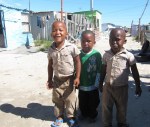
Khayelitsha is a township of two million people outside Cape Town, South
Africa.
I had the pleasure of being able to visit with Jenny Nomvoya Housdon who
works to raise awareness and help the people of Khayelitsha. Jenny showed
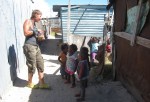
me the home of her adoptive family and we walked around, chatted with the
people who were there during the day, and gave the kids sweets. Jenny
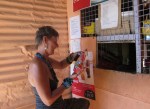
showed me the metal building she and others have acquired to build a
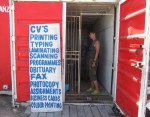
pre-school. Most people here live in shacks made of corrugated metal – some
have “formal” arrangements for water and electricity but most “informally”
get electricity through connecting to the overhead cables and get water
through communal taps. The conditions are inconceivable for most of us but
I was surprised to hear that many people who could leave, don’t –
preferring to stick with the community and family. I learned so much about
life here in a very small time and I’m grateful to Jenny for the
opportunity and the patient explanations.
Racial segregation has been a fact of life in South Africa since colonial
times under the Dutch and the British. The intellectual ideas of apartheid
began to be formed and rationalised in the 1920s and 1930s – take a large
helping of white belief in their destiny to control and improve the world,
add a huge dose of exposure to National Socialism and the Nazi thinkers,
mix in a healthy dose of financial and business self-interest, blend with
support from the Dutch Reform Church, bake for a couple of centuries and,
voila, you have a fully formed but totally unworkable doctrine. All of this
became official government policy with the National Party electoral victory
in 1948.
Just as the rest of the world was heading to de-colonise and reverse
discrimination and domination, South Africa headed aggressively in the
other direction. All citizens were categorised by race and land was
segregated by forced removals of over 3 million people. Non-whites were
disenfranchised in 1970 and blacks deprived of their South African
citizenship; being made citizens of ten “homelands” based on tribe. All
services were segregated and, needless to say, blacks did not get the same
services as whites.
But of course the whole edifice was a farce – you cannot put all the black
people in homelands if you depend on their cheap labour to run homes,
farms, and factories in the white areas. The townships were a compromise to
keep labour close to work that whites did not want to do – and still do not
want to do. The whole edifice crumbled in the 1980s and President De Klerk
released Nelson Mandela and they both steered South Africa away from a
possible civil war to democratic elections in 1994. This was truly a
miracle given the built up hatred.
It would be easy to categorise the townships as just the ugly residue of
apartheid and unique to South Africa but it’s not as simple as that. For
sure, there are a lot of people here whose life has not changed much since
apartheid but every country in the world has large numbers of people for
whom there is no work and little in the way of prospects – favelas and
shanty towns and slums in Sao Paolo, Mumbai, Nairobi. At least here the
government seems to recognise a responsibility to do something and appears
to be trying to help.
Every other Africa country that was released from colonialism seems to have
gone the same way – new leaders promise to create a socialist Utopia, get
elected and realise how impossible that is, then settle for stealing the
country’s resources for their clan and family, then they never leave.
Taylor, Mugabe, Kabila, Daniel arap Moi, Idi Amin, Kagame, Abasanjo – the
list is endless. The fact that South Africa avoided this is truly
astonishing.
As for the townships? Not easy to imagine that these get wiped out any time
soon.
 Colin's Travel Journal