
Africa is Huge.
Riding through Namibia it is necessary to put things in some perspective – the country is over three times larger than Great Britain but with only two million people. Namibia has a GDP of $12B which is about one month of Apple’s revenue. Most importantly for the purposes of the group I am riding with, Namibia is a country with one the lowest percentage of paved roads in the world. Bottom line: If you want to find somewhere that is empty and has lots of fascinating areas to explore on dirt roads, this is your place.
It is also impossible to think about Africa without seeing it through the lens of European colonialism. Every inch, tribe, and tract in Africa was grabbed by one of a few European countries in the so-called Scramble for Africa from 1870 to 1914. The boundaries of all the modern African nations were decided in Lisbon, London, and Paris and ratified at the Berlin Conference in 1885. In this short period these places moved from an indirect dominance through economic or military influence to a full-on direct rule and colonial control. This allowed these countries, including my own, to grab resources to feed their factories and to fights wars with each other in Africa instead of doing it at home. That didn’t last of course and the whole process was reversed after World War II.
In Namibia’s case it was grabbed by Germany in 1884 after one of Germany’s elite, Adolf Luderitz, called for help when he fell out with the locals. Thus Germany was embroiled for 30 years in a guerilla war during which time they committed genocide of the two main tribes and setup a segregation system that was a template for apartheid. After the First World War, the League of Nations gave the mandate for Namibia to South Africa which they only gave up after their embarrassing defeat in the war with Angola. Namibia has been a stable, independent democracy since 1990.
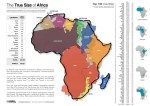
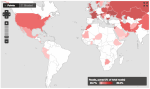
The graphics here show Africa as carved up by Europe, the size of Africa if you plot on a consistent scale, and the countries of the world ranked by the percentage of their roads that are paved. Who knew this data existed?
 Colin's Travel Journal