Moving History from Lycia to the British Museum. Earlier this year we sailed along the Lycian coast in southwest Turkey with a few friends and our own archaeologist on board; Peter Sommer. Peter walked 2000 miles in the footsteps of Alexander the Great to discover Turkey when he was a graduate student and now takes groups by bus or by boat to sample the same experience. Do one of these trips and you’ll thank me afterwards.
Repeatedly, however, we would visit a site and find that much of the finest tombs and temples and artifacts were no longer there; removed or destroyed long ago by conquerors, house-builders looking for stone, or looters looking for profit. In many cases, however, they had been hauled off by Sir James Fellows on a series of visits in the 1840s to gather up antiquities for the British Museum and the walls and gardens of his wealthy patron, Lord Palmerston.
This week I had the chance to close the circle and visit the British Museum to catch up with the pieces of Xanthos that were expropriated by Sir Charles. To be fair, it seems that Lord Palmerston had, in fact, obtained permission from the Sultan at Constantinople to ship some of the artifacts from Lycia, but I doubt that the Sultan realised quite how much would have been carted off. Several ship loads as it happened.
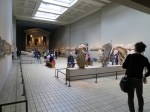
There are three rooms in the British Museum dedicated to Xanthos and the scope is staggering. These rooms are right next to the Elgin Marbles which Greece still wants back by the way – but that’s another story,
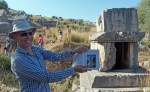
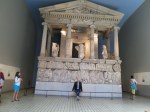
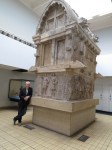
Here you can see what Payava’s Tomb looks like in Turkey today – with Peter Sommer holding the book – and what it looks like rebuilt with the top and side friezes abducted by Fellows filled in with carved limestone. Much more stunning is the Nereid Monument which is a temple tomb from the same site. One side of the tomb is reassembled but the rest of the room contains all the pilfered pieces; absolutely amazing. No wonder there was nothing to see at Xanthos itself; every damn stone is here.
I also learned that Sir Charles (who was knighted after these trips by a grateful nation after carting off Xanthos to England) was a fellow Nottingham lad and that one of his first studies was of Newstead Abbey, the home of Lord Byron, which I used to visit very often when I was a kid and where my parents ended up living next door. Small world.
 Colin's Travel Journal