
Religion in India – It’s Complicated.
My British history classes told me that, after Partition to keep the religious fanatics apart after independence in 1947, India was Hindu and Pakistan was Muslim. End of story. But even a small time traveling in India tells a very different story; with sights and sounds of religious observance from many faiths all around you; all the time. Yes, the country is majority Hindu but there are almost as many Muslims in India as there are in Pakistan, there are maybe 30M Christians of which half are Catholics. Churches are next to Mosques and bells compete with muezzins. Ladies in burkhas shopping with friends in saris. There are certainly significant fault lines around race and caste and religion in India but, everywhere we went, we were told repeatedly that the different groups sort of get along. Maybe that is true. Most of the time.
In Kerala, for instance, India’s most literate state is split equally between Christian, Muslim, and Hindu. Interestingly the Christians, mainly Syrian Orthodox, have been there since Thomas the Apostle visited in AD 52 to try and convert the Jewish settlements that were already there. The Moppila Muslims arrived in Kerala as Arab spice traders from the sixth century, before the prophet had even established Islam in Arabia. There is still also a Jewish community in Kochi that dates back to the arrival of Sephardic Jews in the fifth century but most of them packed up and took off to Israel as soon as that state was established in 1948.
On the train from Ernakulum to Coimbatore, we chatted at length to a young lady teacher who said she was Orthodox Christian but admitted she was also a “secret Hindu” with a preference for Ganesh; the elephant god of good luck. In the search for the hereafter it’s obviously best to keep a few options open; like a Jew wearing a St. Christopher.
In the grounds of the astonishing Maharaja’s Palace in Mysore, there are a number of temples to different Hindu gods and their avatars. The day we were there, one of the Gods, there are millions so I’m not sure which one, was being revered, garlanded, and paraded around in a canopied, huge handcart with loud flute, horn, and drum accompaniment.
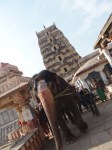
At the Virupaksha Temple at Hampi each morning the elephant god Ganesh blesses the temple in the form of, well, an elephant of course who is marked with the three chalk marks of the blessing by Krishna. At the end of his perambulation he stopped at the top of the sacred ghats from which people were bathing in the river and offered his blessings to those who fed him a banana or offered money. It was amazing to see the faithful stand before Ganesh with a small cash offering held out low with the left hand. The elephant would delicately take the money in the tip of it’s trunk, whisk it backwards to the handler who pocketed the cash almost invisibly while the elephant pendulumed his trunk back and gently laid it upon the worshipper’s head for a few seconds of blessing. A very moving but slick commercial operation.
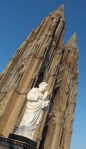
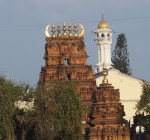
The other two photos are – The beautiful neo Gothic St. Philomena’s Church in Mysore – temple and mosque colocation near the Mysore central market.
 Colin's Travel Journal