
What is Historic? Hampi: A Tragedy in Three Acts
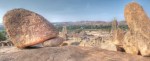
Act1 : The RIse of Vijayanagar. Around 1350 Vijayanagar, the City of Victory, was established as the capital of a Hindu Kingdom that stretched from coast to coast; grown rich controlling the trade in horses and spices across all of South India. In the following two hundred years it grew into a huge, dazzling, well defended city across tens of square kilometers with markets and temples in granite surrounded by the bizarre landscape of huge boulders thrown there, according to the Ramayana, by the warring monkey kings Bali and Sugriva and their ambassador Hanuman. Visitors of the period recorded the wealth and splendour of the city, the bazaars of silks and gems, the beauty of the temples, and, not least, the availability and skills of the thousands of bejeweled courtesans. This all came to an end in 1565 when one too many wars with the Muslims to the north resulted in the city being attacked, besieged, and sacked; everything but the immovable stone and granite was destroyed or carried off. End of Hindu Kingdom.
Act2 : Hampi Bazaar. From the rubble of the destroyed city, the village of Hampi emerged to house local farmers and small businesses that then, and now, catered to those making the tourist trip or religious pilgrimage to the sites and temples of Vijayanagar that are still revered and active. Now five hundred years old, the scruffy village of Hampi provides everything that the modern, hippy traveller requires: cheap rooms, simple food, tee shirts, and free WiFi. A story of building one town from the rubble of another that has been repeated a million times. In an Indian context, Shiva destroys then Brahma creates.
Act3 : UNESCO and the Indian Government. This area has now, deservedly, been given UNESCO World Heritage status and the Indian Government has started to take steps to protect the site. The first act of “protection”, however, was to demolish most of Hampi that had clung the original ruins; huge swaths of the village along the old bazaar and down to the ghats on the river have already been bulldozed and they are now chipping away to finish that phase leaving parts of the old bazaar looking like war-torn Syria. This being India, the owners have been given laughably small sums in compensation and kicked out and the rest of the village is living on borrowed time; in three to ten years it’ll be gone.
These actions seem absurd; demolishing centuries old buildings to “save” even older ones is like demolishing Avebury to save the Neolithic stone ring, flattening Cirencester to save Roman Corinium, or demolishing Cairo to protect the pyramids. The Indian government calls this “restoration” but it’s really vandalism.
The whole enormous area of temples and palaces is a truly staggering and charming and fascinating place to spend a few days. Get there while you can.
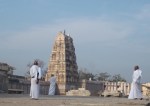
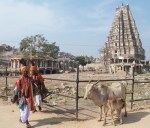
Photos: The Virupaksha Temple to the local form of Shiva and the river beyond from the nearby hill of boulders – Two sadhus ready to pose for money and mother buffalo and calf with the gopuram (gateway) to the Virupaksha in the distance – Three worshippers at dawn before the temple – Colin and his new best friend in the alleys of Hampi village.
 Colin's Travel Journal