

The history of South America is simple – Act One: Indian Civilisations – Act Two: Spanish Conquest – Act Three: Armed Chaos.
Sitting here in Cartagena, Colombia, it is possible to imagine that this is the place that closed all three acts. Let me explain.
The first people of the Americas were Indians that are known to have migrated from the north and settled in dozens of separate sedentary cultures all over the South America. Most got on with their neighbors except for the Incas, Maya, and Aztecs who grew by conquest. These groups had barely developed technology past Bronze Age levels but they did all have laws, science, architecture, science, order, writing, and culture.
All this came crashing to a very rapid end with the arrival of the Spanish and the Conquistadors.
We all know that the first of these, Christopher Columbus, sailed the ocean blue in fourteen hundred and ninety two. In 1499, the first European, Alonso de Ojeda, set foot in Colombia at Santa Marta just up the road from here and was the first to realize, or the first to openly admit, that they had not actually discovered a passage to Asia. No matter, there’s gold and bounty here so onwards to conquest and glory.
Close of Act One, here in Cartagena; the end of indigenous dominance at the start of the very rapid destruction of the Indian civilisations.
It is hard to grasp how quickly Spain grabbed the Americas. The Pope granted permission to Ferdinand and Isabella of Spain to do what they liked with their new possessions as long as they converted the indigenous people to the Catholic church and sent tribute back to Rome. They and the Conquistadors did both with a staggering level of efficiency.
La Conquista really got going around 1510 and by1540 Spain controlled almost all the territory from Canada to the Antarctic. Except the Amazon – the Pope had given that to Portugal. Hernan Cortez defeated the Aztecs (1521), Francisco Pizarro saw off the Incas (1532), the Maya took a bit longer but almost a hundred years before the Mayflower sailed to Plymouth, Spain controlled two continents and set about extracting their wealth for three hundred years.
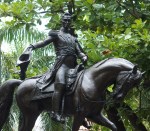
The end of the Spanish started with rebellions in the 1780s in the Spanish possessions in the Caribbean inspired by the French Revolution and the American Declaration of Independence. But the real heavy lifting of dispossessing the Spanish was led by Simon Bolivar, El Libertador. (No doubt we’ll talk about Jose de San Martin later when we are in Chile and Argentina). Bolivar started the process with an appeal for money and men to the wealthy Creoles in 1808 when he was only 25 years old. By the time he was 38, he had raised and led armies to free and create the countries of Venezuela, Colombia, Ecuador, Bolivia (named for him), and Peru and had been named President of all of them at one time or another. But by 1830 he had given up on his dream of a unified continent and, broken, penniless, and sick, he began the journey to exile from Colombia. He ended up in Cartagena but could not bring himself to step onto any boat that would take him away into exile. He died in Santa Marta from complications from syphilis, cirrhosis, malaria, and tuberculosis. All signs of a life lived to the fullest one can suppose.
Close of Act Two, here in Cartagena and the start of the post-liberation politics of South America.
The Spanish were gone and so was Bolivar’s dream of a single new unified country. The oligarchs and local leaders all had their interests to defend and expand and the entirety of Latin America has been in a state of armed chaos ever since. In Colombia alone, after Bolivar died in 1830 there were over 50 armed insurrections against the government before the end of that century. It is impossible to count and explain the ups and downs of military and democratic power for the last almost two hundred years; revolutions, juntas, left wing, right wing, Shining Path, dictators, the millions of disappeared and dispossessed.
In Colombia this month, however, one of the bloodiest and nastiest of these epochs is scheduled to come to an end with the signing of a peace deal between the Colombian government and FARC rebels – Communist insurgents since La Violencia in 1946.
Maybe the end of Act Three is starting to take place – here in Cartagena.
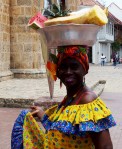
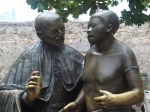
PHOTOS: No city in most of South America is complete without an equestrian statue of Simon Bolivar looking down on the tourists and pigeons. The Fruit Ladies in Cartagena sell their wares over the city with colorful dresses and equally colorful language. Everyone needs a hat. The statue of Saint Pedro Claver with one of his slaves – this seems like an oxymoron to me – how can you beatify anyone who kept slaves – only the Vatican knows. Paleteria has wonderful flavors
 Colin's Travel Journal