

Peru Farmers Union Meeting
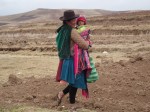
As we left Laguna Pacucha and headed to Cusco on Saturday, we came across this gathering at the side of the road. I managed to talk to a couple of the people who were still turning up and learned that this was the regular meeting of the farmers’ union.
The men were ranged on bleachers dug from sod around a square meeting place and the women were close at hand to share what was going on and look after the children; and perhaps to check how much money the men were supposed to be bringing home every week. In the middle a few were men addressing the crowd that was clearly paying very close attention. They were surrounded by their fields at 12,000 feet elevation and the women were in open toe sandals.
It would have been fascinating to get closer to see what was going on but this party was definitely invitation-only and my Quechua is a little rusty anyway. I am sure they were talking about the usual farmer stuff like market prices and the weather but there also seem to be two big themes that are animating indigenous politics in these parts.
First, the threat to traditional farming. The people here have been managing to farm in this hostile environment for a millennium and they’ve learned a few things. Traditional methods involve a high degree of sharing of seeds and knowledge and the campesino farmers have become the main conservers of genetic diversity, native crops and their wild relatives. This is under threat from big agricultural concerns that would love to be able to deliver genetically modified seeds and their expensive custom fertilizers and pesticides. In this model the farmer owns the seeds the same way we own software; we have a license to use it but we can’t copy it. This would be the end of any kind of seed preservation and sharing and a blow to biodiversity – and the Andean Quechua are having none of it.
Second, these people may be poor but they have power; Peru is a democracy and these farmers vote. In 2001 Alejandro Toledo was the first President from an indigenous Quechua family and he held his inauguration at Machu Picchu instead of the capital, Lima – Francisco Pizarro must have been turning in his grave. But I digress. In 2011 Peru passed a law “Protecting the Collective Knowledge of Indigenous Peoples” that requires prior informed consent from communities before accessing traditional knowledge and is supposed to enforce sharing of benefits. The right to save and use seeds is also recognized in national law.
So far it seems that the “sharing of benefits” part of the equation hasn’t worked out too well – trickle down economics is as big a hoax in Peru as it is in the US. Imagine that.
But the good news part of this is that the poorest of the poor have a voice in these debates. In our corporatized US Congress, I cannot imagine the interests of indigenous people or poor small farmers being given this much attention in the face of big ag business lobbying.
 Colin's Travel Journal