
Riding the Rusted Rails
The railways in the countries we have visited service minerals not people.
Building railways in the Andes is not a very practical proposition in the first place, exports are more important than public transport, and the major population centers are in some very crazy places; La Paz and Quito for instance are in deep valleys which is great for keeping the wind off but totally impossible to build railways.
Bolivia’s railway network started out with a plan to connect the mines through Uyuni in the Altiplano to the coastal port of Antofagasta. At the time that city was part of Bolivia but, after the War in the Pacific that was fought in 1880s between Peru and Bolivia on one side and Chile on the other over an argument about the taxation of railways as it happened, Bolivia ceded Antofagasta to Chile and became a land-locked nation.
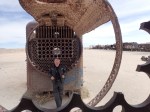
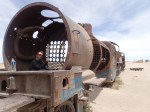
The rails were built, equipped, and operated by British companies floated on the London stock exchange. Uyuni is still a rail crossroads but a collapse of the mining industry in the 1940s resulted in dozens of steam engines and rail cars being simply abandoned on a spur outside the city. Some of these engines are a hundred years old and are being gradually etched away by the salt air or being pillaged to sell for scrap.
We had time to make a quick lunch stop here and Fonz and I found some shade inside the firebox of one old locomotive. As we left, one of the tour operators was clearly upset that we had ridden our go-anywhere bikes right up to the line of rusting hulks. Hey man this is a scrapyard, not the Smithsonian.
One historic oddment. The ladies in Bolivia in traditional dress, las Cholitas, all wear dandy little bowler hats and how they wear their hat sends a signal about marital status; level is married, at a jaunty angle means single or widowed. These hats arrived in Bolivia originally for the railway engineers but, when they had too many small sizes, an entrepreneurial salesman peddled them to the local ladies who thought they were cool and practical and it obviously caught on – here we are a century later.
 Colin's Travel Journal