Darwin Was Here
Traveling today around and across the Andes off the main routes, as we are doing, can be a grueling and dangerous experience. We have ridden dozens of roads that are very high on the internationally recognized “Do NOT Fuck Up Or You Will Die” scale.
Crossing the pre-Cordillera into Mendoza from Uspallata with a view behind us of the high Andes that have to be crossed to get to Chile, you cannot help but get a new appreciation of the tenacity of the earliest travelers in these parts.
One of those was Charles Darwin. In 1831 he embarked on the Beagle as a 22 year-old recent graduate and naturalist for a voyage that was planned for two years but would last five. He paid his own way (with help from his father’s brother-in-law Josiah Wedgewood of fine pottery fame) so that he could maintain control over anything he collected, and he saw his role more as companion to the Captain Robert Fitzroy than having any grand scientific scheme in mind. Both these obviously changed as he learned more about Fitzroy and the natural world he documented.
By 1835, relations between the erratic and difficult FitzRoy and Darwin had reached a low point and they decided they needed some alone time. The Beagle was anchored at Valparaiso and Darwin decided to take a month long trip to Mendoza and back with ten mules, one horse, and two guides. In the previous month he had seen the eruption of Mount Osorno and been on the ground at Valdivia when one of the worst earthquakes hit Chile and leveled the town.
At that time scientists did not see themselves as scientists but as broad thinkers and investigators. Darwin saw that, after the earthquake some mussel beds had risen a couple of feet and he began to agree with Charles Lyell’s theory that the earth was not formed by huge upheavals (vulcanology) but by little changes over a huge length of time.
As Andy Dufresne says in The Shawshank Redemption, “Geology; just pressure and time”.
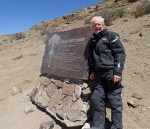
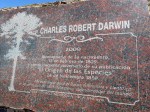
Mendoza now is a delightful place that is the centre of Argentina’s wine industry but Darwin called it “a forlorn and stupid town”. On his journey here he passed the same road we used. Along the way there is an almost invisible memorial to the fact that Darwin discovered fossilized sequoia trees that could not have grown at 9,000 foot elevation but must have been, like the mussels, pushed here by massive forces over an unimaginable period of time.
He did not publish any of this until years later but on the bicentennial of his birth (1809) and the 150th anniversary of the publication of The Origen of Species (1859), this plaque was erected at the supposed spot of this discovery.
The original plaque was vandalized by creationists so this is a larger, thicker replacement and it has to be the most remote and unheralded monument I have ever visited; stuck in the middle of 100 Km of dirt road next to a worked out silver mine.
In the 2002 poll commissioned by the BBC for the program 100 Greatest Britons, Charles Darwin was ranked fourth behind Churchill, Brunel, and Lady Di – so maybe the list was a product of the time. He was honored by being put to rest in 1882 in Westminster Cathedral but a memorial in the remoteness of the Argentinian Andes also seems very fitting.
 Colin's Travel Journal