

Magellan and Patagonia
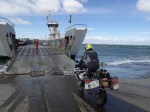
Now we have completed the final leg of our journey across the Straits of Magellan from Patagonia to Tierra de Fuego and back into Argentina. Almost to Ushuaia.
Today this is a very fast, friendly, and professional ferry trip across the narrow strait. Though it is definitely a challenge to ride a big bike onto the ferry across the surf and off again in a howling cross wind that is normal here. Commit or get wet.
The first European to explore this area was Ferdinand Magellan; a Portuguese navigator working for the Spanish king to find a back door to Asia. He was the first to circumnavigate the globe in 1521 and found this protected passage around the cape that now bears his name.
Magellan also named Patagonia. There are a few different accounts of how Patagonia got its name but the most plausible etymology is the simplest. Magellan was a fan of a popular Spanish chivalry novel by Francisco Vasquez whose title character, Patagon, was a savage giant. Shakespeare also stole characters from this book that showed up in The Tempest.
When Magellan’s crew met the native Tehuelche indians they found they were quite a bit taller than the Europeans and, like all sailors stories about women, and storms, and monsters that get exaggerated in the telling, they were subsequently described as giants and called Patagons.
Around this time the Spanish Conquistadors were starting their conquest of the continent from the east and the north but they never, not in the 300 years of Spanish rule of South America, bothered to conquer Patagonia; there was no gold to mine, no civilizations to plunder, and it is damned cold and windy. So they never bothered. It was left to the newly independent Chile and Argentina to subject the Mapuche and Tehuelche indians in the 1830s. Eventually the Mapuche from the west overran the Tehuelche in the east and now they are all but decimated as a people.
The original Patagons no longer exist in Patagonia.
 Colin's Travel Journal