Welsh in Wales for Who?
Our chosen route from London to Ireland led through Wales to the ferry at Holyhead. A blast across England on the motorways then to Shropshire, into Wales and through the Snowdonia National Park where Edmund Hillary trained for the ascent of Everest; beautiful country for climbers, hikers, bikers, and sheep and pretty much nobody else.
The Welsh cling tenaciously to their isolation, their uniqueness, and their traditions – male voice choirs, druids, Eisteddfods, and an old Celtic language that has impossibly long words with almost no vowels; spoken only in Wales and Chubut Province, Argentina. A long story.
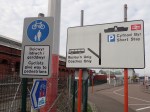
Everywhere in Wales the public signage is in both languages as you would expect in this cultural enclave but I wonder how many people this is for. I understand the power of nationalism and Plaid Cymru but do we really need both languages everywhere? There are about half a million people in the country who speak Welsh – 20% of the population.
But you only need dual language signs for public safety if there are people who ONLY speak Welsh (monoglots) and wouldn’t otherwise get the message. So how many people only speak Welsh? The answer is ZERO. Apparently 50 years ago it was common but now it is unheard of for anyone over the age of 4 to not speak English.
SO – the signs are just for show – to confuse the tourists and to reassure the Welsh that they are still in Wales and voted for Plaid Cymru.
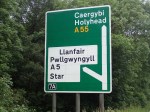
Talking of long words. The place with the longest name is, unsurprisingly, in Wales. The village of Llanfairpwllgwyngyllgogerychwyrndrobwllllantysiliogogogoch is by the Menai Strait in Anglesey and, again unsurprisingly, the name does not fit well on road signs as shown here. The name is pronounced “lan-vire-pool-guin-gith-go-ger-u-queern-drob-ooth-clandus-ilio-gogo-goch … and … translates roughly as “St Mary’s Church in the Hollow of the White Hazel near a Rapid Whirlpool and the Church of St. Tysilio near the Red Cave”.”
Welcome to Wales.
 Colin's Travel Journal