


Belfast: Troubles + Titanic = Tourists
Belfast seems to have reinvented itself by showcasing the tragedies of its past. The place is bustling, and confident, and almost cosmopolitan – now about 80 cruise ships dock here every year opposite the slip from which the Titanic was launched in 1912.
TITANIC
The Titanic Museum is one of the best in the world – an interactive and fascinating trip through the history of the city, the development of shipbuilding up to the Harland and Wolff epoch, and the construction and destruction of their most famous ship. “Built by Irishmen but, to be sure, crashed by an Englishman”. There is even a multi-storey adventure ride through an imagined shipyard to give you an idea of the lives of those who worked on it.
TROUBLES
The Troubles, or the Northern Ireland Conflict, is the name given to the sectarian civil war that took place from 1969, when British troops were brought in to support the Royal Ulster Constabulary who were failing to control the violence between Unionists who were generally Protestants loyal to the British crown and Nationalists who were generally Catholics who wanted a united Ireland. The end only came in 1998 when the Good Friday Agreement was signed. Over 3,500 people were killed, half of them civilians, and about 50,000 injured in this nonsense. Today the people who live here try to stick to the principles of “Remember, Respect, Resolution” but the fault lines are still there and the architecture remains to remind us.
Belfast’s taxi drivers have become the de facto tour guides to the areas affected by The Troubles and we had a great afternoon with Joe who took us to see the areas that are still bedecked with competing signs of their allegiances, and grievances, and heroes – William of Orange in the Shankhill area and, in the Republican areas, murals of Patrick Pearse and James Connolly who led the Easter Rising in 1916. Joe did a terrific job explaining the history of both sides and wove in several stories of his own life and family.
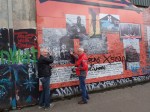
Here we are adding our graffiti signatures to the “peace line” wall that separates nationalist and unionist neighborhoods and Joe showing us a picture of his grandfather who served in the British Army in the First World War. (He was injured and flagged down an ambulance only to find that it had been hijacked by two German soldiers who took him prisoner and certainly saved his life by keeping him from fighting in the Somme.)
 Colin's Travel Journal