



Lumber production is measured in board feet.
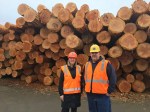
Despite living in Oregon timber country for almost 30 years, until last week I had no idea what a board foot was or how a lumber mill worked. Then I had the opportunity to visit the Hampton Lumber mill in Willamina, Oregon – Timbertown USA – guided by mill manager Brad Blackwell.
So … I now know that one board foot is a piece of wood 12” x 12” x 1” and the Willamina mill produces 2 million board feet of timber PER DAY – roughly 6,000 trees felled from private and public lands up and down Western Oregon.
Fun fact: one million board feet is abbreviated MMBFM – an interesting mixture of Latin (thousand thousand) and English (board foot measure).
The flow of log trucks into the this site is constant. They are quickly unloaded and the contents measured by independent government inspectors to make sure the loggers and the mill do not fall out over who paid for what. The raw logs are then trucked into a machine for removing bark and cutting to manageable lengths before rolling into the mill proper.
Walking through the mills created two distinct impressions for me. First it is exactly as you would expect – noise and sawdust and big rumbling machines managed by big burly guys in hard hats and serous Carhart outfits. The real Oregon exactly as you imagine it has been for over 150 years.
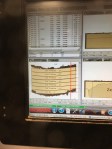
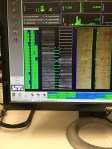
But then the degree of precision and automation and computer assistance came as a big surprise – each log is rolled and sized with lasers so that the mill can be programmed to extract the maximum amount of finished lumber at the highest possible quality – the smaller mill even has the ability to measure the shape of the log and cut timber on a curve to get 20% more out of some logs. Finished pieces are photographed on the end grain as they flash through to establish their “fingerprint” so that they can be dropped into the correct bin after grading. The adjustment of the kerf (distance between points in a saw blade) by a few thousands of an inch can make a few hundred thousand dollars difference to final lumber output.
The result of this automation certainly improves safety and injuries but it also, clearly, reduces the number of employees and increases profitability of producing lumber. There are 240 people working in this mill and it produces close to 10% of Oregon’s finished dimensional lumber output.
Comparing the 1970s to today – Oregon timber employment has gone from 80,000 to 30,000 (down 63%) while the output has gone from 8 Billion board feet to 4 Billion board feet per year (down 50%). Overall the timber industry was 12% or Oregon’s GDP in the 1970s and it is now only 2% of GDP.
For Willamina, however, this industry is 100% of the GDP.
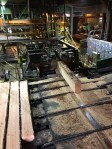
Photos: Enormous thanks to Brad Blackwell for taking three hours to show us the mill from end to end – FInished lumber about to be dried for a few days – The operator of the Quad Mill showing the screen displaying the cross section of the log and the pieces it will be cut into – Blades cutting logs to 20′ lengths for the smaller mill – Computer screens showing a curved scan and the end grain fingerprints of the finished lumber being graded – The first cut is the deepest – Serious warning signs – Beckie Lee and Brad Blackwell
https://oregoneconomicanalysis.com/2012/01/23/historical-look-at-oregons-wood-product-industry/
 Colin's Travel Journal