
How Do You Define the Outback?
We have asked people along the way how we’ll know we are in the “outback” and nobody has provided us with anything like a clear definition. The other day one chap said “Well, it’s not an exact science is it mate? It’s where the bitumen ends and nobody lives unless that have to”. The last part of the answer clearly had a racist overtone; only indigenous aboriginal people (blackfellas) “have to” live there. But the young lady running the William Creek Hotel also said it was for people “who couldn’t function in cities”; misfits who find their way here like her, “home is my car really, and I’ll move on when it gets too hot”. That day is approaching fast.
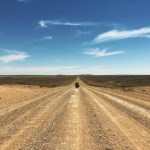
One thing is certain, if the outback is a physical definition, we are clearly in it now. We left the beauty of the hills and creeks and gum trees in the Flinders Ranges and headed north to Marree and along the Oodnadatta Track to William Creek, along the southern edge of Lake Eyre; the lowest point in Australia where the rains from Queensland come a thousand miles to evaporate and die.
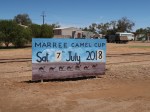
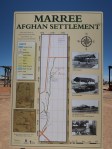
Marree is the turn off to the Birdsville Track and was once a settlement for Afghans who came to run the camel trains. We met a few locals at lunch and one claimed he had Afghan blood. There are the remains of an old mosque and there is a camel festival and race every year.
The Oodnadatta Track is more or less the route of the old railway line and the Overland Telegraph Line to Darwin that was surveyed by the explorer John McDouall Stuart in 1861, and has been a major aboriginal trade and dreaming route for millennia. Coming north to Marree out of the Flinders the vegetation disappears and, leaving Marree, you step into a whole nother world of emptiness; occasional glimpses of Lake Eyre which was wet for a couple of months this year but is now a glimmering white sheet of salt. In 1964 Malcolm Campbell came here to Madigan Gulf and ran Bluebird across the salt at 403 mph for a new land speed record. These efforts are now on more accessible lake beds. From here it is nothing followed by nothing by nothing for 200km to William Creek.
William Creek is in the middle of the Anna Creek Station, the world’s largest working cattle station. This station is over 9,000 square miles (7 million acres) with around 18,000 cattle in a good year but in drought conditions we have not seen a single creature but flocks of parakeets.
We feel like we have arrived in the middle of the country but we are not even close – it is still another 1,000 Km to Uluru (Ayer’s Rock) and we are not going that far.
 Colin's Travel Journal