

Three Things Unique to New Zealand – Kiwi, Maori, Kauri (PART ONE)
We were only in New Zealand for a few days but I wanted to do three things you can only do here – see a Kiwi, meet a Maori, and hug a Kauri.
These are not as easy to do as you might imagine.
First the Maori.
New Zealand was one the of last places on earth to be settled by humans when Kupe sailed in from Samoa around 1250. He had seen the annual bird migration of the Godwits, figured they must have to land somewhere, followed them to the most northern tip of New Zealand, and found paradise in the Bay of Islands. Six hundred years later the British showed up and started to trade with the (now) Maoris. As a sign of how committed this relationship was, two Maori chiefs were invited to England to meet the King and to work with academics at Cambridge to develop an alphabet for the Maori language in use today.
In 1840 the relationship between Britain and the Maori was cemented in a treaty and that location is now the most important Maori historic site in the country – the Waitangi Treaty Grounds. The treaty is still technically in force and still being debated today. Our guide was Nate (nah-tay) Kana who claims to be descended from one of the signatories to that treaty but anyone who can prove their Maori lineage back to the 1860 census is legally Maori – now about 600,000 (15% of the population) mainly concentrated in the North Island near where they originally landed.
The Maori are a large share of the poor of New Zealand but, from the start, the British had a very different relationship with the Maori than with the Aboriginal population in Australia – one was a trading partner the other a victim of genocide – and the racist vibe is still only felt in Australia. The Maori also help New Zealand win at rugby – maybe that’s a factor too.
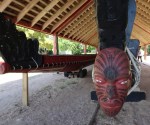
The Ceremonial War canoe was built in the 1950s and is launched every year on the anniversary of the treaty. It was renovated in 1974 for the Queen’s visit and after she rode in it, she designated it “Her Majesty’s Ship” so it’s now part of the Royal Navy.
 Colin's Travel Journal