Riding the Rusted Rails

The railways in the countries we have visited service minerals not people.

Building railways in the Andes is not a very practical proposition in the first place, exports are more important than public transport, and the major population centers are in some very crazy places; La Paz and Quito for instance are in deep valleys which is great for keeping the wind off but totally impossible to build railways.

Bolivia’s railway network started out with a plan to connect the mines through Uyuni in the Altiplano to the coastal port of Antofagasta. At the time that city was part of Bolivia but, after the War in the Pacific that was fought in 1880s between Peru and Bolivia on one side and Chile on the other over an argument about the taxation of railways as it happened, Bolivia ceded Antofagasta to Chile and became a land-locked nation.

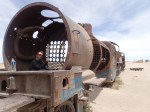
The rails were built, equipped, and operated by British companies floated on the London stock exchange. Uyuni is still a rail crossroads but a collapse of the mining industry in the 1940s resulted in dozens of steam engines and rail cars being simply abandoned on a spur outside the city. Some of these engines are a hundred years old and are being gradually etched away by the salt air or being pillaged to sell for scrap.

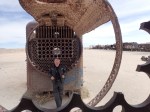
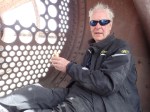
We had time to make a quick lunch stop here and Fonz and I found some shade inside the firebox of one old locomotive. As we left, one of the tour operators was clearly upset that we had ridden our go-anywhere bikes right up to the line of rusting hulks. Hey man this is a scrapyard, not the Smithsonian.

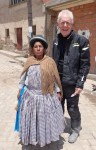
One historic oddment. The ladies in Bolivia in traditional dress, las Cholitas, all wear dandy little bowler hats and how they wear their hat sends a signal about marital status; level is married, at a jaunty angle means single or widowed. These hats arrived in Bolivia originally for the railway engineers but, when they had too many small sizes, an entrepreneurial salesman peddled them to the local ladies who thought they were cool and practical and it obviously caught on – here we are a century later.
Crossing Salar Uyuni in the Bolivian Altiplano

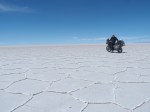
This is the world’s largest salt flat and contains a number of major roads across the Altiplano. The real fun is blasting off away from those routes but you get a real shock when you stop and actually feel the razor sharp salt after you’ve ridden at 115mph across it. 

Like Sailing Without Currents

The Salar de Uyuni is 5,000 square miles of evaporated salt in the Altiplano in southern Bolivia. It is perfectly flat to within one meter over its entire extent though we did have to have a discussion on geodesics and gravity after I got the question “If it is entirely flat how come you can see the curvature of the Earth?”.

The solid surface is rock hard and forms distinctive hexagonal tiles with raised edges that are a function of the crystalline structure of the salt. The surface is remarkably hard and sharp; if you fell off your bike at speed, it would be like landing on the world’d biggest and sharpest belt sander; you would be shredded. Goodness knows how much we all shortened the lives of our tyres.

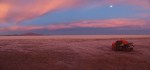
We had the opportunity to spend the night camping on Isla Pescada surrounded by salt and a beautiful sunset. To get there we rode across the untracked salt from the north side of the ancient lake at Jirira and then rode east to get to “dry land” again at Colchani; crossing the solar from north west to south east was a 200 kilometer voyage. On both legs the best way to navigate is by compass and holding a constant heading; just like sailing except you do not have to allow for currents or tides.

The serious dare is to peg the throttle in top gear and keep your eyes closed for five minutes. I decided this would stay on my bucket list for a little while longer. The easier challenge is to write your name on the salt and record it on your GPS track. Next time.

At the end of the day, all the bikes were caked in a substantial layer of salt that had to be thoroughly washed off – the car washes in Uyuni were doing good business.

Photos: Bike and rider and salt – sunset from Isla Pesada – Tiles of salt – Navigation on the Salar Uyuni 

Sin historia; no futura

On our first night out of La Paz, we stayed in the guest house and bunkhouse on Teneria Ranch that has been in the family of Hans Hesse for generations. He and his family welcomed us with open arms and made a fantastic dinner of roast pork and local vegetables and fresh bread; all from their huge outdoors bakers’ oven.

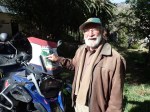
We chatted for a while as a test of his patience and my Spanish; him wearing his Oakland As baseball hat for which there was no explanation. Hans was born on this farm 80-odd years ago and, until he was seven, only spoke Aymara learned from his grandmother. He moved to La Paz to go to college and then moved to Germany where he worked for a manufacturer of heavy lifting machinery in the docks at Kiel and Bremen. He traveled often to the US on business from Germany and knew San Diego. He must have done alright as he retired at 46 and, because “the pension was not paid until age 65” he moved back to family farm where it was cheaper to live.

He told me about his four kids, his Chinese motorbike that he still rides everywhere, the buildings on the farm that dated back 600 years and bemoaned the fact that the original buildings, whose foundations still poked through the grass, were perfectly aligned to catch the winter and summer sun on different walls but were torn down anyway.

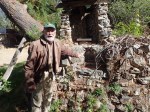
He then described the family memorial in the centre of the property which pre-dates the arrival of the Spanish and was originally Aymara, converted to Quechua, then finally extended with Catholicisation to include a cross and a small niche for a statue of the Virgin. The tree behind the shrine was pushed over by a cow and they just propped it and the pine just grew that way. Don Hans told me that the bones of many of his ancestors on his mother’s side are interred here, as he expects to be in his time.

He is very proud of the clean air and good living in the mountains here and said that the air is so clear that in the 90s they used to regularly see UFOs. At the point I said that he had lost me but he said “It must have been true as they said so on the radio”.

I thanked him for taking the time to share his stories and family history. He thanked me graciously for taking an interest and he said “Sin history, no futura”.

Without a history, you don’t have a future.

Staggering Natural Beauty vs: Ugly Daily Reality

The story of how I got assaulted by an old drunk woman in Cohoni, Bolivia.

Of the six countries we are visiting on this journey, Bolivia is by far the poorest. For comparison, the GDP per Capita of the USA is $57,000. Chile and Argentina are both about half the US – Peru, Colombia, Ecuador are half of Chile and Argentina – Bolivia is half again at $6,000. It is pretty safe to assume that most of the people we met riding through the Cordillera Quimsa Cruz south of La Paz are living lives that are economically well below their average countrymen. Many are likely living on subsistence farming where they are not even counted in the GDP because they generate no economic activity.

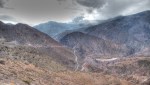
South of La Paz, we rode along the Rio Choqueyapu through a valley of small farms and then climbed up the first of a number of spectacular mountain passes where people were scratching a living on ever smaller and ever higher terraces. These are beautiful mountains and valleys that fill the horizon for hundreds of miles as we tracked around the snow capped Nevada Illimani.

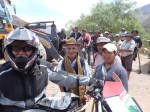
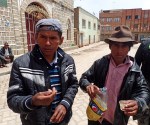
The road was dirt but well maintained and we shortly came across a large road crew grading and repairing the surface. When they saw a group of gringos on large bikes they decided that this was too good an opportunity to miss and blocked our path demanding a toll – literally highway robbery. After a lot of back and forth we settled on 50 Bolivianos – about $8 – paid to the old gentleman seen here leading the negotiation. There were at least 20 men in this group so we have no idea how the bounty was divided up. We heard later that this likely went into a community fund; but I’m not convinced.

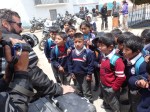
In Cohoni we stopped for snacks, ice cream, or a quick meal from the only cafe in town. As usual a group of school kids gathered to find out what we were doing and we handed out business cards with a map of the ride. Chris White is seen here with Sterling Noren filming the question and answer session both ways.

At the other end to the plaza, there was a group of men and women sitting the shade of the church and passing around a very large bottle of local moonshine. They had obviously been passing this bottle around for a long time and they were all very drunk. I went over to chat and declined a glass of the booze and then one of the ladies asked me to take a picture with her. She was very well turned out in traditional clothes and bowler hat. She was of indeterminate age, and well the worse for the alcohol. Nontheless, she confided that I should not talk to the men “pero son todos borrachos”. Because they are all drunkards. So far all good fun but then she said that I should pay her for the photo as it was going to go “all around the world”. Correct.

I gave her a couple of coins and she thrust them back at me saying she wanted 50 Bolivianos and then the guy with the bottle and the hat said they wanted 100 Bolivianos. I politely refused and a bunch them grabbed my camera. These are people used to manual labour and had very firm grips. I made it very clear that they were getting neither 100 Bolivianos nor my camera but arguing with drunks is a one-sided conversation. Eventually, with help from my friends, I got the camera back and walked away but not before the old lady ran after me pounding angrily on my back; presumably because she was too short to reach my head.

The darker footnote to this was that one of the little 9 year old girls ran over and, with an air of sadness and resignation, grabbed the arm of the man with the hat and the bottle and led him away from the fracas. We assume this was her father and she wanted to make sure he did not get into any more trouble. She was being asked to be adult long before she should have been.

The Only Way is Up.

Traveling in South America is a constant battle between the outstanding natural beauty and the choking poverty and pollution of the towns and cities. Towns overrun with farm animals, construction and detours everywhere, roads jam-packed with ubiquitous passenger vans shuttling people in all directions, and buses and trucks with unmaintained diesel engines spewing carcinogens in indiscriminate black clouds.

La Paz, Bolivia is a perfect example. There is no city in the world more visually stunning than La Paz; sitting in a canyon that has protected if from the Altiplano winds and worst of the high altitude weather for centuries, the views of the city are amazing from the edge of the cliff. The city was originally a small mining town when the Spanish showed up and took over. Today it is spilling further and further down the canyon with unplanned building on every slope. Sadly the white capped Mount Illimani was masked by train clouds today but normally makes a thrilling backdrop.

But the combined population of La Paz and neighbouring El Alto is over 2.3 million and they are crammed into a place with no level ground and no history, money, or ability to create effective public transport. When we arrived into El Alto, the main road to La Paz was dug up for over five kilometers and we resorted to just riding our big BMW go-anywhere bikes along the roadworks just ignoring the puzzled onlookers who scurried out of the way.

It seems that the citizens of El Alto are fed up with the roadworks too. When I tried to get a cab to a famous overlook spot, every road was blocked with peaceful demonstrations by local lady organisers campaigning against the mayor of El Alto. “Less money on roads and more money on education” was the basic message. Luckily I got out of there before rush hour as you cannot imagine the chaos that was about to occur.

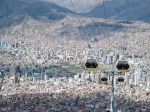
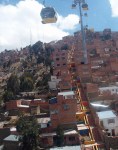
That is not to say that the city isn’t trying to do something about public transport. If you cannot dig a metro or lay railway lines or build freeways, where can you go? You go UP. The city now has three working lines of the Mi Teleférico system that looks like it ought to be running up a swanky Swiss ski slope. The pylons take up almost no room, the system is quiet and non-polluting, and the sensation of flying above the chaos is electrifying. I rode the system up to the edge of El Alto, then all the way back to the south side of the city. Very impressive.

Photos: The Yellow Line Teleférico that runs from downtown La Paz to the edge of El Alto 2000 feet higher – The Teleférico over the previous technology the yellow stairs up the El Alto – Ladies complaining to the Mayor about roadworks – Panorama of La Paz from El Alto.

Whatever Floats Your Home

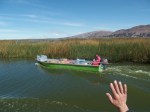
Today we visited the Uros Islands in Lake Titicaca that straddles the border between Peru and Bolivia and met five families on one island. There are now 87 islands with 4,600 inhabitants and three elementary schools – all floating on rafts of reed roots covered with layers of reeds.

This island lifestyle started as a defensive strategy against the Inca as the islands could be detached and moved. This did not stop the Uro people who intermarried and merged with the Aymara from being conquered and enslaved by the Spanish. Today about half their income comes from sharing their stories and lives with tourists but they mainly commute to school and jobs on the “mainland” in Puno.

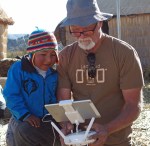
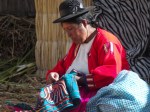
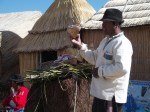
Photos: Jim Hyde getting lots of help from Miguelito flying the drone to film the islands – a demonstration of how the islands are built and the political hierarchy of the island from the president of this island – fresh reeds and fresh water being delivered (the lady delivering the water was not pleased to be photographed as she was breast feeding whilst driving) – one of the ladies doing embroidery for sale – tired visitors returning home.

I’ll take COUNTRIES NAMED FOR PEOPLE for $400 Alex

There are three of them in South America – one for Christopher Columbus (Colombia) and two for Simon Bolivar (Bolivia and the Bolivarian Republic of Venezuela)

As we learn about history we are drawn to the stories of great people and we develop a short list of our own heroes; complex characters who changed the world whilst dealing with their own demons. Growing up in the UK my history lessons focused on the people who put the greatness into Great Britain and my own two obsessions have been Lawrence of Arabia and Winston Churchill.

But I think that Simon Bolivar deserves to be on that list. His story is astonishing and complex and the opportunity for one person to achieve what he accomplished could only have happened in the early nineteenth century.

He was born into wealth and educated by his nurse, a family slave, and tutors. He traveled in Europe as a military cadet, witnessed the coronation of Napoleon at Notre Dame, and came home with a head full of ideas from the enlightenment. He put his life and money into leading a military liberation of a continent from Spain at the age of 25 and was appointed President of Venezuela (by age 30), Gran Colombia (present day Colombia, Venezuela, Ecuador, Panama), Bolivia, and Peru. His first wife died and he stayed true to his vow to marry nobody else but had a voracious appetite for women; some of whom appear to have been offered him by grateful citizens. He did have one constant lover, Manuela Saenz, who prevented an assassination attempt against him and was a collaborator to the point he called her “Libertadora del Libertador”.  His dream of a politically unified continent fell apart under the pressure and greed of the church and the local oligarchs who settled the borders of the current countries of South America. He died a broken man unwilling the leave the countries he had liberated and ruled.

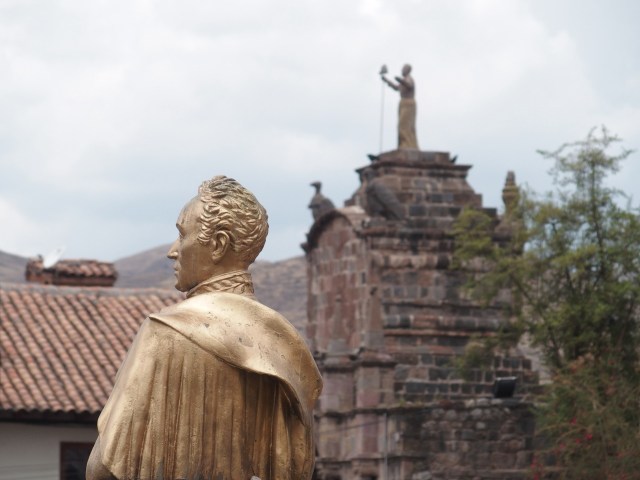
Our ride so far has passed through a few of the key places in Bolivar’s story. We started in Cartagena where he died, passed through Ayacucho where the Spanish were finally defeated, and then to Cusco where the statue here celebrates his lap of honor in 1825 through many of the cities that revered him.

One book to get the flavour of his whole life is “The General and His Labyrinth” by Gabriel Garcia Marquez that describes the last 30 days of his life as he left Bogota and his dreams behind and could not bring himself to step on the boat at Cartagena and accept exile.

Colca Canyon Condors

If you want to see Andean Condors then you have to go to Colca Canyon in southern Peru. The ride along the edge of the canyon from Chivay is spectacular reason alone to come here. The locals claim that Colca Canyon is the world’s deepest but Peru’s own tourist organization says that honor belongs to Cotahuasi Canyon just west of Colca and the Chinese say THEY have the deepest at Yarlung Zangbo in Tibet. It depends how you measure it seems but Colca is breathtaking enough and surrounded by volcanoes in various stages of activity. 

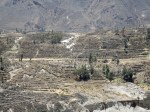
The canyon is intensively farmed with astonishing terraces along every feasible slope and hand made walls that must have been built over centuries.

The main condor hangout is at a location where the canyon narrows and the wind blows constantly. We spotted this guy showing off by effortlessly strafing us. Condors can have wingspans of up to 10 feet and are jet black all over. This one was smaller than that and fluffier and grayer so probably a youngster. They can live to be 50 years old and mate for life.

Peru Farmers Union Meeting

As we left Laguna Pacucha and headed to Cusco on Saturday, we came across this gathering at the side of the road. I managed to talk to a couple of the people who were still turning up and learned that this was the regular meeting of the farmers’ union.

The men were ranged on bleachers dug from sod around a square meeting place and the women were close at hand to share what was going on and look after the children; and perhaps to check how much money the men were supposed to be bringing home every week. In the middle a few were men addressing the crowd that was clearly paying very close attention. They were surrounded by their fields at 12,000 feet elevation and the women were in open toe sandals.

It would have been fascinating to get closer to see what was going on but this party was definitely invitation-only and my Quechua is a little rusty anyway. I am sure they were talking about the usual farmer stuff like market prices and the weather but there also seem to be two big themes that are animating indigenous politics in these parts.

First, the threat to traditional farming. The people here have been managing to farm in this hostile environment for a millennium and they’ve learned a few things. Traditional methods involve a high degree of sharing of seeds and knowledge and the campesino farmers have become the main conservers of genetic diversity, native crops and their wild relatives. This is under threat from big agricultural concerns that would love to be able to deliver genetically modified seeds and their expensive custom fertilizers and pesticides. In this model the farmer owns the seeds the same way we own software; we have a license to use it but we can’t copy it. This would be the end of any kind of seed preservation and sharing and a blow to biodiversity – and the Andean Quechua are having none of it.

Second, these people may be poor but they have power; Peru is a democracy and these farmers vote. In 2001 Alejandro Toledo was the first President from an indigenous Quechua family and he held his inauguration at Machu Picchu instead of the capital, Lima – Francisco Pizarro must have been turning in his grave. But I digress. In 2011 Peru passed a law “Protecting the Collective Knowledge of Indigenous Peoples” that requires prior informed consent from communities before accessing traditional knowledge and is supposed to enforce sharing of benefits. The right to save and use seeds is also recognized in national law.

So far it seems that the “sharing of benefits” part of the equation hasn’t worked out too well – trickle down economics is as big a hoax in Peru as it is in the US. Imagine that.

But the good news part of this is that the poorest of the poor have a voice in these debates. In our corporatized US Congress, I cannot imagine the interests of indigenous people or poor small farmers being given this much attention in the face of big ag business lobbying.