If You Are A Tourist – Be A Tourist

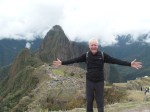
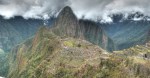
A few lovely days off in Cusco at the centre of the Valley of the Incas and a day trip by boringbus-twistytrain-scarybus to get to Machu Picchu, the former country retreat of the Inca kings. Cusco really is a beautiful city that has retained enough of its different periods of greatness to have rich pickings for the wandering tourist. Machu Picchu was breathtaking (literally if you started to rush around the ruins at 8,000 feet elevation) under the glowering rain clouds.

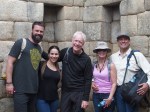
Photos here: Plaza de Armas in the Centro Historic with the Basilica Cathedral on one side and the Iglesias de la Compania on the other. Panorama of Machu Picchu from the postcard photo spot where the Inca Trail drops into the city. Typical tourists visiting Machu Picchu. Tourist picture of woman and grand-daughter and pet lamb. Tea selection in the lobby of my hotel – Coca, Coca, Coca, or Coca – Oh I’ll have Coca please.

I Met This Lady and Immediately Made a Connection

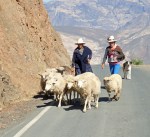
There are lots of perils to look out for on Peru’s roads – aggressive lunatic drivers in barely maintained cars, deep culverts off narrow bumpy twisty roads, rain channels that are invisibly deep and slippery, and tiny ladies in multiple frilly petticoats and big felt hats herding sheep with all the time in the world. 

But this one was new to me.

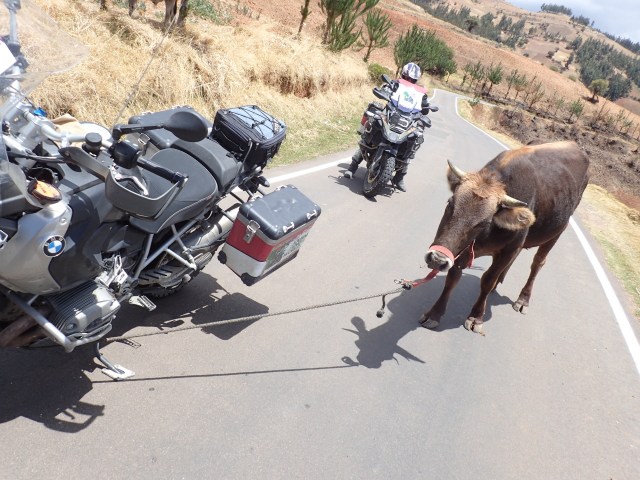
Leaving Ayacucho on a very narrow and twisty road connecting all the small farms, I saw a line across the road. At the last minute I realized that it was actually a rope tethering a cow to a tree. The radius from the tree had allowed the cow to cross to find better grazing and the tether was strung across the road. Before I could react it was whipped under my front wheel, and then jammed into the sump guard. I was stunned and the cow was none too pleased to be yanked rudely off her favorite grass and dragged rapidly down the road until I stopped.

I was worried that she could easily have pulled the rope tight and flipped the bike but she just stood there passively while Pablo managed to extract the rope. She did evacuate her bowels in front of us of course; which was nice. I’m not sure if this was from fear or just to show what she thought about her mistreatment.  I’m just glad she hadn’t pulled the line tighter or this story may have had a more interesting and less humorous ending.

Women Are Less Corrupt Than Men

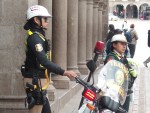
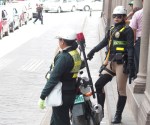
At least that is what senior police officers believe in Peru. Drive anywhere in Peru and you will see the traffic at rush hour being directed by lovely young ladies on motorcycles in crisp green uniforms, Ray Bans, tan jodhpurs, and riding boots. Since 1998 these women have been in the vanguard of helping to improve the public perception of law enforcement in a country known for rampant corruption. Male traffic cops have been assigned to desk jobs and the ladies have taken over – everywhere.

Today 11 percent of officers in the PNP (Peru’s National Police) are women but in the Lima traffic division a staggering 93 percent are women. The police bosses are happy “since female officers are more harsh at giving tickets, strict and difficult to bribe.” but it seems that a lot of taxi drivers were initially up in arms at the fact that they could no longer get away with driving recklessly in unsafe cars; they used to be able to pay to get away with it – but not now.

The ladies here are in Cusco as the policy has spread across all of Peru with great success. I cannot imagine the kind of lewd comments and disrespect that these women must encounter every day in this macho Latin country, but I surely do not plan to mess with them whilst I am here.

We Had Terrorists Before Al Queda

Every time a brown person with a name like Mohammed attacks someone, the American media swings into full hysteria and claims that the country faces an existential threat from Islamic terror. This is total nonsense; more people were killed in the US last year by armed toddlers than by sworn terrorists. But fear makes headlines and drives ratings; myths and rage continue to be good business and good politics.

We have had terrorism in our midst for decades of course. The Jewish Zionist Haganah tortured and killed British soldiers and ethnically cleansed villages in Palestine in order to stake out the new State of Israel. In my own lifetime the troubles in Northern Ireland spilled across Great Britain as Catholics and Protestants killed, tortured, and bombed in a battle to protect the lies they tell their children on Sundays. There was the Red Brigade, the Bader Meinhof Gang, and Basque Separatists. All left wing armed groups trying to make themselves heard in an indifferent world; like little children lying on the floor saying they won’t breathe until they get dessert.

In Peru, their period of domestic home-grown terror came from the Shining Path; from the founder of the Communist Party in Peru “Marxism-Leninisn will open the shining path to revolution”. This organization was founded in the 1960s by a Abimael Guzmán, a philosophy professor at the university in Ayacucho and for a decade or so he found willing recruits in the impressionable students and the working indigenous Quechua farmers who were being ignored by the government that, at the time, was a military dictatorship. Both these groups thought that the Shining Path would help them on the road to social justice and tackle the extreme economic inequalities and the exploitation of people in the highlands.

When elections were allowed in 1980, however, this turned into armed violence with the destruction of private property, burning of ballot boxes, and assassinations. Despite the fact that Guzmán said that “the triumph of the revolution will cost a million lives”, the government initially ignored the violence but eventually reacted then overreacted with the indigenous communities caught in the middle being brutally treated by both sides for assumed cooperation with the other. The Shining Path extended its campaign across the country but their homeland was the Andean highlands which they controlled for over a decade until Guzmàn was captured and sentenced to life in 1992 and his cohorts over the next few years.

In Ayacucho there is a small dusty museum run by a group of Quechua women who lost family members to this insanity. Their organization was founded in 1983, long before the “civil war” came to an end with the goal of bringing these crimes against their husbands, children, and fathers to the attention of a larger world. There is still a lunchroom there to take care of orphans of political violence.

Pablo and I visited and talked to the docent about her life. She lost her father when she was a small child and explained the evolution of the conflict and the wrongs that are still un-righted. She was particularly emotional when she told us that many of Guzmán’s lieutenants are now being released at the end of their jail terms and returning to join the remaining 500 or so Shining Path members now in the Amazon part of Peru trafficking cocaine.  

Overall 69,000 Peruvians suffered violent deaths during this period and the majority being from the country’s poorest who suffered murder, torture, rape, and forced disappearance. But how can you show this in a museum? All they can do is reflect the media coverage at the time and include art projects that portray how those affected feel.

The motto of the museum is “So this never happens again” Well of course it can’t, can it? I’m not so sure.

We now have politicians all over the world attempting to rise to power by demonizing others; including one that wants to be the leader of the free world. They all point to another group to blame for your problems and promise to make that group go away. Pick your responsible party – the king, the tsar, the capitalists, the bourgeoisie, the Jews, the “welfare queens”, the “takers”, or the immigrants. Off with their heads and your problems are solved. We know that’s not the case but it drives ratings and votes.

So I’m back where I started. Beware simple answers, selfish media, and angry citizens at your peril.  

Dear Abby – I am becoming an Adventure Tourism Snob. Please help.

Over this last month, I have been traveling by motorbike along the Andes with a group of friends; starting in Cartagena, Colombia, passing through Ecuador, and now in Cusco, Peru. We have stayed in condos, hotels, hostels, and camped on farms, by lakes, and under the tailings of a gold mine. Our beds have cost everything from $3 to hundreds per night. One night we stayed at a beach compound that would have made a down market refugee camp. Our food has varied from haute cuisine to simple local grills to an excellent chicken soup with the feet floating in it.

We have ridden on every kind of road from first class motorways to dodgy dangerous hillclimbs to deep water and mud to dirt roads that felt like they were made of pebbles mixed with sand like talcum. 

We have been to towns and villages that have rarely, if ever, seen strangers passing through and we have been greeted and welcomed with complete warmth and generosity everywhere we have wandered.

Today, though, I am in an upscale hotel in Cusco for a couple of days to regroup and get cleaned up and refreshed for the rigours to come in Bolivia and the Altiplano and the Atacama. The hotel is filled with earnest westerners with the right gear and the right cameras about to enjoy the Valley of the Incas and Machu Picchu. The hotel even offers an option to add oxygen to the air in your room in addition to guide and spa services.

And this is the first time in a month that I have felt like a tourist.

A lady this morning at the truly world-class breakfast buffet was complaining that she could’t find her favorite cheese and that the toaster wasn’t as quick as the one at home. I felt like grabbing her and saying “Ferfucksake woman, I ate in a restaurant last week that had a fly paper hanging over the table. And Señor Alvarez put us up in his guest room for $3. Get over it and stop bothering these people!”

I feel angry and alien. Do I need help?

La Policia LatinoAmericana

The police forces of Latin America do not have a very good reputation for honesty. They are rarely trusted by their citizens, they are underpaid, and often resort to creative ways to increase their compensation by taking a bite out of locals and tourists alike.

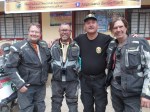
Our experience so far in South America has been the opposite. Maybe because we are big men traveling in packs on big garishly decorated bikes who always attract a crowd. This is not the perfect environment for petty graft as it would be very difficult to pick on us singly or to privately extract a bribe.

But, call me naive, I haven’t seen even a hint of this. Every interaction is with officers who have behaved politely and professionally. The police in Cartagena helped direct our night ride in the Plaza Grande, highway patrol cars often wave us past over double yellow lines at highly illegal speeds, the policeman is always one to ask for a photograph, traffic police break away from checking bus and truck papers to talk to us, motorcycle cops have waved and saluted us, and small town police have more than once organized impromptu crowd control to allow us safe passage.

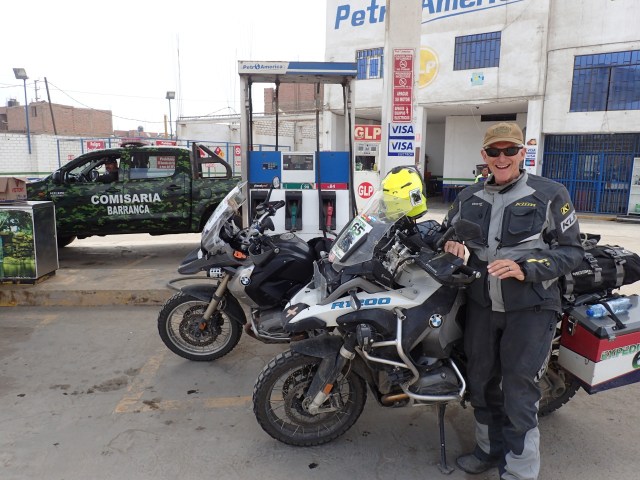
Today a few of us stopped in a grubby dusty little town just off the Pan Americana north of Lima for fuel and snacks. We left our bikes in the shade of the gas station awning and went into the little store for sugary goodies. After a few minutes one of the local police trucks pulled up and the senior officer engaged us in conversation, asked about our trip, shook all our hands, and then pointed out that this was one of the highest crime neighborhoods in Peru. If our bikes, stuff, and helmets were not nailed down, they could disappear in a flash. The store clerk confirmed that recently two armed guys had stolen two motorbikes from this very gas station. We stood to leave but the officer said “No, please finish your drinks, my colleague and I will guard your bikes”. They then parked next to the bikes for as long as it took us to get dressed and ready to go, wished us “Buen viaje” and left.

My overall impression is that these officers are just as curious and impressed with our trip as everyone els but they also want these crazy, high profile foreign visitors to be made welcome and for them to leave with a positive image of their country and their community.

Thanks for your help officers. Protect and Serve.

The Rio Tablachaca Valley – The Most Dangerous Road I’ve Ridden

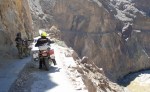
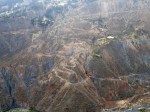
Riding in the Andes is breathtaking, electrifying, and completely terrifying. Leaving Pallasca we dropped 7000 feet onto the Rio Tablachaca on roads where there was absolutely zero room for error; one slip and there was the abyss.

All of this road was paved once upon a time but now large sections have slipped away after landslides or earthquakes and have been crudely patched. Even on the sections that are still intact and paved, the trucks and buses have ripped every hairpin bend into potholes and huge sections have a mound of pebbles and scree in the center of the road; no problem for the trucks but a nightmare for motorbikes. Pucker Factor – off the scale.

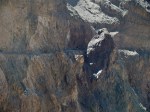
Photos here – Huge colorful panoramas around every bend but you’d better stop to enjoy; cannot look at the road and the scenery at the same time.  Evan and Chris dropping down one section of hairpins. Font and Bill pausing before heading for the traverse further down the canyon. Evan riding the edge of the canyon on a road that was barely carved out of the vertical cliff. Fonz coming out of one of the tunnels in the lower section of the road. Amazing to realize that there are people who make a life and farm in this hostile landscape.

Angasmarca Knows How to Throw a Party

Angasmarca is an unremarkable town. There are no pre-Incan ruins, no Spanish colonial buildings, no handicrafts markets. Just a concrete little farming town with a small concrete plaza separated from any passing tourists by difficult dirt roads over almost impenetrable mountains.

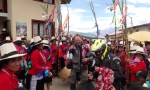
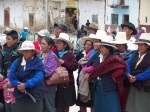
But we rode into Angasmarca on the town’s birthday – the 31st annual celebration of its founding – and the people here are obviously very proud of their town and very happy to celebrate. Our path was blocked in every street and we stopped by the town plaza to see what was happening. It seemed that every school, church, civic organization, and indigenous culture had its own group parading for the rest of the town; marching, singing, and dancing and being applauded from a sea of leather faces and big straw hats.

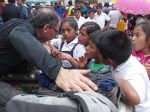
As usual, we were initially ignored but very soon the curious kids and more adventurous adults came over to chat and a conversation started about who we were and why we were in their inaccessible town this lovely Sunday afternoon. Then came the photographs, and well wishes, and welcomes, and giggles, and a general breaking down of barriers that happens every time we stay long enough.

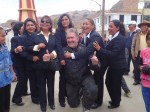
As we were getting ready to leave there appeared a couple of groups of people dressed in their cultural colors carrying palm fronds and each led by a man in a typical knitted mask with holes for eyes and mouth. Suddenly we were surrounded; pulled in by the masked leader with a rope in the form of a snake. First Fonz and Bill, then Pablo on his bike, then me when I tried to extract us from the celebration to hit the road. Obviously it was considered rude to leave before they had finished their song but we had to leave. This is no place to be riding at night.

Finally the police officer, with his ancient revolver, helped us steer away the people so we could ride and not hurt anyone. Angasmarca we will be back on your next birthday.

Fernando in Huamachuco

We arrived in Huamachuco in the Northerm Highlands of Peru looking for lunch, a place to rest, and some time to plan where we could camp that night. There was a political rally blocking one side of the town plaza but on the other side we found a restaurant. Across the street there was a couple of old gentlemen watching the world go by as they probably did most days.

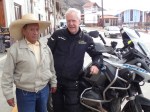
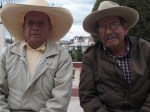
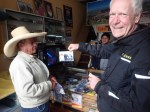
We had our usual group of interested onlookers appear around the bikes and ask who we were, where we were from, and what we were up to but these gents remained reserved and distant; old-fashioned manners perhaps making it neither dignified nor polite to mob the strangers. So I went over and sat on their wall and chatted and, despite my poor Spanish and their accents, found out that Fernando and Cesar were farm workers who had retired long ago and had exactly the same questions as everyone else but didn’t want to bother us. He took a photo of me with his ancient cell phone and warmly welcomed me to his town. I asked if he wanted a picture of him on the bike. He said he was way too old for that kind of nonsense but asked for a picture with me. He then said he’d like a copy and I asked for his address in order to send one. He said “No, not in the post. Now” and pointed to Foto Rodriguez in the corner of the plaza. So a few minutes later I handed over the card from my camera and Señor Rodriguez produced two 4×6 glossy photos and adamantly refused to accept payment.

Fernando took the photo politely with dignity but without a smile. In the street he then unexpectedly hugged me and went on his way. We’d both made each other’s day very special.

Hospitality In Pallasca

The plan for the day was to leave our camping near Huamachuco and ride the backroads of the Northern Highlands of Peru on the west slope of the Cordillera Central of the Andes, get lunch at the small hill town of Pallasca, and head south to find another place to camp.

It did not quite turn out that way – but as one door closes another opens.

The gravel roads were generally well looked after but narrow and very twisty – no complaints there from this group but nobody was looking to go very fast. The scenery here is magnificent and cresting every rise opens up another astonishing vista; distant mountains and intensive agriculture at elevations higher than the summit of Mount Hood. Another fascinating glimpse into other people’s lives.

Then the road became paved, plunged into the valley of the Rio Tablachaca, and zigzagged up the other side; probably the finest and most dangerous motorbike roads I have ever ridden. It is impossible to photograph and adequately convey the thrill of seeing the road on the other side of the valley and realizing that we were going to ride all the way down and then across the side of the next mountain.

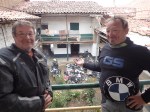
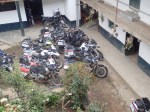
We finally arrived in Pallasca at 5:00pm, an hour before dark, and learned that the other half of the group had chosen a different route and one of them had broken down.  After a quick enquiry, we found Hostal Alvarez as our digs for the night – $3 a bed and an internal courtyard to keep the bikes and their contents safe. Comfortable beds and cold water was all we needed and all we got.

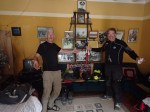
Bill and Chris stayed in the owner’s suite with all his mementoes of his military service and an inexplicable fake Christmas tree.