Officially On The Road 

 Yesterday we spent about six hours extracting 15 bikes, one truck, one trailer, and an unconscionable amount of other stuff from the hands of Colombian customs in the port of Catagena. Usually this can take days and we are forever in the debt of Victor Sierra who runs Valley Group Cargo and is an enthusiastic motorcyclist, and his amazing staff, for their energy and patience in getting us on the road. This could have been a nightmare but it went way better than expected. 

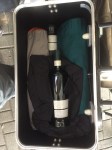
 My bike fired up first time, the two bottles of whisky had not been commandeered by US or Colombia customs, and then we were into rush hour traffic to get outta there. 

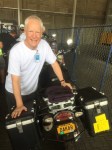
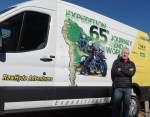
After one more day of reorganizing our crap and adding the team colors to our bikes via plastic wraps, we are now ready to head south in search of South America.

Photos: Bike wrapped – Final paperwork – Whisky – Bike off the boat – Official pass to get into the Customs hall.

The history of South America is simple – Act One: Indian Civilisations – Act Two: Spanish Conquest – Act Three: Armed Chaos.

Sitting here in Cartagena, Colombia, it is possible to imagine that this is the place that closed all three acts. Let me explain.

The first people of the Americas were Indians that are known to have migrated from the north and settled in dozens of separate sedentary cultures all over the South America. Most got on with their neighbors except for the Incas, Maya, and Aztecs who grew by conquest. These groups had barely developed technology past Bronze Age levels but they did all have laws, science, architecture, science, order, writing, and culture.

All this came crashing to a very rapid end with the arrival of the Spanish and the Conquistadors.

We all know that the first of these, Christopher Columbus, sailed the ocean blue in fourteen hundred and ninety two. In 1499, the first European, Alonso de Ojeda, set foot in Colombia at Santa Marta just up the road from here and was the first to realize, or the first to openly admit, that they had not actually discovered a passage to Asia. No matter, there’s gold and bounty here so onwards to conquest and glory.

Close of Act One, here in Cartagena; the end of indigenous dominance at the start of the very rapid destruction of the Indian civilisations.

It is hard to grasp how quickly Spain grabbed the Americas. The Pope granted permission to Ferdinand and Isabella of Spain to do what they liked with their new possessions as long as they converted the indigenous people to the Catholic church and sent tribute back to Rome. They and the Conquistadors did both with a staggering level of efficiency.

La Conquista really got going around 1510 and by1540 Spain controlled almost all the territory from Canada to the Antarctic. Except the Amazon – the Pope had given that to Portugal. Hernan Cortez defeated the Aztecs (1521), Francisco Pizarro saw off the Incas (1532), the Maya took a bit longer but almost a hundred years before the Mayflower sailed to Plymouth, Spain controlled two continents and set about extracting their wealth for three hundred years.

The end of the Spanish started with rebellions in the 1780s in the Spanish possessions in the Caribbean inspired by the French Revolution and the American Declaration of Independence. But the real heavy lifting of dispossessing the Spanish was led by Simon Bolivar, El Libertador. (No doubt we’ll talk about Jose de San Martin later when we are in Chile and Argentina). Bolivar started the process with an appeal for money and men to the wealthy Creoles in 1808 when he was only 25 years old. By the time he was 38, he had raised and led armies to free and create the countries of Venezuela, Colombia, Ecuador, Bolivia (named for him), and Peru and had been named President of all of them at one time or another. But by 1830 he had given up on his dream of a unified continent and, broken, penniless, and sick, he began the journey to exile from Colombia. He ended up in Cartagena but could not bring himself to step onto any boat that would take him away into exile. He died in Santa Marta from complications from syphilis, cirrhosis, malaria, and tuberculosis. All signs of a life lived to the fullest one can suppose.

Close of Act Two, here in Cartagena and the start of the post-liberation politics of South America.

The Spanish were gone and so was Bolivar’s dream of a single new unified country. The oligarchs and local leaders all had their interests to defend and expand and the entirety of Latin America has been in a state of armed chaos ever since. In Colombia alone, after Bolivar died in 1830 there were over 50 armed insurrections against the government before the end of that century. It is impossible to count and explain the ups and downs of military and democratic power for the last almost two hundred years; revolutions, juntas, left wing, right wing, Shining Path, dictators, the millions of disappeared and dispossessed.

In Colombia this month, however, one of the bloodiest and nastiest of these epochs is scheduled to come to an end with the signing of a peace deal between the Colombian government and FARC rebels – Communist insurgents since La Violencia in 1946.

Maybe the end of Act Three is starting to take place – here in Cartagena.

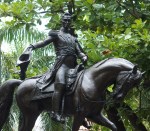
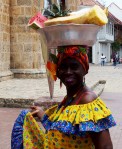
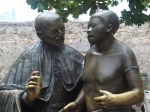
PHOTOS: No city in most of South America is complete without an equestrian statue of Simon Bolivar looking down on the tourists and pigeons. The Fruit Ladies in Cartagena sell their wares over the city with colorful dresses and equally colorful language. Everyone needs a hat. The statue of Saint Pedro Claver with one of his slaves – this seems like an oxymoron to me – how can you beatify anyone who kept slaves – only the Vatican knows. Paleteria has wonderful flavors
This is the plan for the next couple of months. Expedition65.

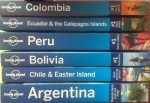
By the numbers:  the idea is that 15 gentlemen with 5 nationalities on 15 BMWs with 2 guitars, one van, one trailer, one 8Kw generator, one driver, and one cook (his nickname is El Gordo so we’ll see how many calories we consume) will ride 10,000 miles through 6 countries (Colombia, Ecuador, Peru, Bolivia, Peru, Argentina) with 13 international border crossings and 18 crossings of different parts of the Andes across 65 degrees of latitude in 65 days with 53 days of riding from sea level (Caribbean in Cartagena) via a few 15,000 foot passes in the mountains (Abra del Acay on Ruta40 in Argentina) back to sea level (the Beagle Channel at Ushuaia in Tierra del Fuego, Argentina)

Next stop Cartagena, Colombia.

Awesome Alps with Globebusters.

The Alps were formed – are still being formed I suppose – by the pushing of the Africa plate against the European land mass. Just like today, everything in Africa and the Middle East wanted to migrate to Europe and Europe pushed back. The result is a dramatic rocky barrier from the Mediterranean to the Adriatic; from Nice to Vienna; steeper on the Italian side from where it was pushed.

Clearly people have lived here for millennia and crisscrossed the passes but the main driving force for anyone to bother trying to systematically build crossings through the region was military. The Romans discovered and exploited the easier crossings to raid and conquer the lands beyond and the most notable counter attack was led by Hannibal and his Carthaginian army helped by elephants in 218 BC. Napoleon famously crossed the Alps in 1800 to take parts of Italy that had been seized by the Austrians and the first carriage roads were built by Napoleon to speed troops across his Empire. The main passes used by the Romans, Hannibal, and Napoleon are still the main routes cross the Alps today and we rode a bunch of them – Stelvio, Umbrial, St. Gothard, San Bernadino, Splügen passes.

These roads now are a compulsive all-you-can-eat buffet of the finest driving, motorbiking, and cycling roads in the world. We rode 49 passes and, easily, 3000 hairpin bends in five countries over seven days of exhilarating riding and dramatic views on roads that are generally quiet and in fantastic condition. The sensation is addictive and insatiable and we barely scratched the surface.

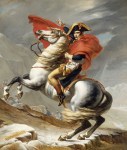
I bet that most motorbikers enjoying this area feel just like Napoleon in the classic painting “Napoleon Crossing the Alps” by Jacques-Louis David.

The other photos here:
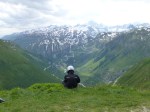
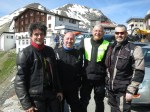
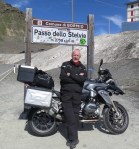
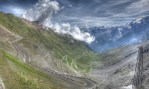
– Sitting contemplating the Grimsel Pass in the distance climbing up and over the Bernese Alps in Switzerland – The group at the top of the Stelvio Pass with Dom Davis, our trusty hooligan leader from Globebusters in the left – The Stelvio Pass looking down at the first couple of dozen hairpins out of a total of 48 turns that drop 6,000 feet in a half hour ride – The perfect bike for the job the new BMW R1200GS which was faultless escaping the UK in the rain and hurling around the curves in the mountains.

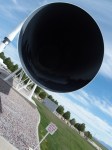
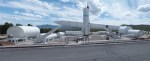
Orbital ATK – On the road north from the Golden Spike National Historic Park, in the middle of flipping nowhere Utah, you come across a display of America’s most famous rockets whose names represent a who’s who of the drive to win the Cold War and conquer space and the dodgier parts of Earth. Orbital ATK is a company created last year as a merger or Alliant and Orbital Sciences to create a $4.5B defense and space contractor and they are the main contractor developing the next generation solid fuel boosters for the Space Launch System that will succeed the Space Shuttle.

The large horizontal rocket is the Space Shuttle booster. The tallest one is the Minuteman which is the only remaining land-based ICBM which came into service back in 1962. Also on display here are an array of other rockets meant to do damage in all sorts of ways – Polaris and Trident are submarine launched ICBMs, Patriot is a surface to air missile, Sidewinder is air-air, and Hellfire is air-ground.

It seems that here in Promontory, Utah they make the motors for missile systems from Raytheon and others and the facilities are scattered far and wide – assume they don’t want an accident in one plant to blow up the whole of bloody Utah.


Spiral Jetty into the Great Salt Lake 

Many people make the 25 mile detour off I-15 through Salt Lake City to visit the Golden Spike National Historic Site; the place where Leland Stanford drove the final spike to create the first transcontinental railway linking the Union Pacific and the Central Pacific railroads in 1869. But 20 miles of easy dirt road further on, and totally without any signposts indicating that it is even there, is Robert Smithson’s Spiral Jetty reaching out into the Great Salt Lake; one of the most beautiful pieces of outdoor and natural art in America.

Robert Smithson created this in three weeks in 1970 with a small team, a backhoe, and a dump truck; moving six thousand tons of mud, basalt and salt to form a 1500 foot long anti-clockwise spiral pathway. He created this when the lake was particularly low and it became submerged in 1972 only to reemerge encrusted with salt as the water level receded around 2002.

For more on Smithson’s tragically short life and career – http://www.theartstory.org/artist-smithson-robert.htm

What is Historic? Hampi: A Tragedy in Three Acts

Act1 : The RIse of Vijayanagar. Around 1350 Vijayanagar, the City of Victory, was established as the capital of a Hindu Kingdom that stretched from coast to coast; grown rich controlling the trade in horses and spices across all of South India. In the following two hundred years it grew into a huge, dazzling, well defended city across tens of square kilometers with markets and temples in granite surrounded by the bizarre landscape of huge boulders thrown there, according to the Ramayana, by the warring monkey kings Bali and Sugriva and their ambassador Hanuman. Visitors of the period recorded the wealth and splendour of the city, the bazaars of silks and gems, the beauty of the temples, and, not least, the availability and skills of the thousands of bejeweled courtesans. This all came to an end in 1565 when one too many wars with the Muslims to the north resulted in the city being attacked, besieged, and sacked; everything but the immovable stone and granite was destroyed or carried off. End of Hindu Kingdom.

Act2 : Hampi Bazaar. From the rubble of the destroyed city, the village of Hampi emerged to house local farmers and small businesses that then, and now, catered to those making the tourist trip or religious pilgrimage to the sites and temples of Vijayanagar that are still revered and active. Now five hundred years old, the scruffy village of Hampi provides everything that the modern, hippy traveller requires: cheap rooms, simple food, tee shirts, and free WiFi. A story of building one town from the rubble of another that has been repeated a million times. In an Indian context, Shiva destroys then Brahma creates.

Act3 : UNESCO and the Indian Government. This area has now, deservedly, been given UNESCO World Heritage status and the Indian Government has started to take steps to protect the site. The first act of “protection”, however, was to demolish most of Hampi that had clung the original ruins; huge swaths of the village along the old bazaar and down to the ghats on the river have already been bulldozed and they are now chipping away to finish that phase leaving parts of the old bazaar looking like war-torn Syria. This being India, the owners have been given laughably small sums in compensation and kicked out and the rest of the village is living on borrowed time; in three to ten years it’ll be gone.

These actions seem absurd; demolishing centuries old buildings to “save” even older ones is like demolishing Avebury to save the Neolithic stone ring, flattening Cirencester to save Roman Corinium, or demolishing Cairo to protect the pyramids. The Indian government calls this “restoration” but it’s really vandalism.

The whole enormous area of temples and palaces is a truly staggering and charming and fascinating place to spend a few days. Get there while you can.

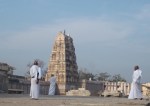
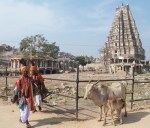
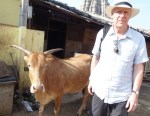
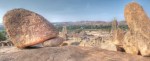
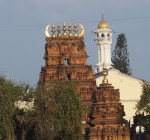
Photos: The Virupaksha Temple to the local form of Shiva and the river beyond from the nearby hill of boulders – Two sadhus ready to pose for money and mother buffalo and calf with the gopuram (gateway) to the Virupaksha in the distance – Three worshippers at dawn before the temple – Colin and his new best friend in the alleys of Hampi village.

Religion in India – It’s Complicated.

My British history classes told me that, after Partition to keep the religious fanatics apart after independence in 1947, India was Hindu and Pakistan was Muslim. End of story. But even a small time traveling in India tells a very different story; with sights and sounds of religious observance from many faiths all around you; all the time. Yes, the country is majority Hindu but there are almost as many Muslims in India as there are in Pakistan, there are maybe 30M Christians of which half are Catholics. Churches are next to Mosques and bells compete with muezzins. Ladies in burkhas shopping with friends in saris. There are certainly significant fault lines around race and caste and religion in India but, everywhere we went, we were told repeatedly that the different groups sort of get along. Maybe that is true. Most of the time.

In Kerala, for instance, India’s most literate state is split equally between Christian, Muslim, and Hindu. Interestingly the Christians, mainly Syrian Orthodox, have been there since Thomas the Apostle visited in AD 52 to try and convert the Jewish settlements that were already there. The Moppila Muslims arrived in Kerala as Arab spice traders from the sixth century, before the prophet had even established Islam in Arabia. There is still also a Jewish community in Kochi that dates back to the arrival of Sephardic Jews in the fifth century but most of them packed up and took off to Israel as soon as that state was established in 1948.

On the train from Ernakulum to Coimbatore, we chatted at length to a young lady teacher who said she was Orthodox Christian but admitted she was also a “secret Hindu” with a preference for Ganesh; the elephant god of good luck. In the search for the hereafter it’s obviously best to keep a few options open; like a Jew wearing a St. Christopher.

In the grounds of the astonishing Maharaja’s Palace in Mysore, there are a number of temples to different Hindu gods and their avatars. The day we were there, one of the Gods, there are millions so I’m not sure which one, was being revered, garlanded, and paraded around in a canopied, huge handcart with loud flute, horn, and drum accompaniment.

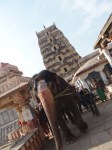
At the Virupaksha Temple at Hampi each morning the elephant god Ganesh blesses the temple in the form of, well, an elephant of course who is marked with the three chalk marks of the blessing by Krishna. At the end of his perambulation he stopped at the top of the sacred ghats from which people were bathing in the river and offered his blessings to those who fed him a banana or offered money. It was amazing to see the faithful stand before Ganesh with a small cash offering held out low with the left hand. The elephant would delicately take the money in the tip of it’s trunk, whisk it backwards to the handler who pocketed the cash almost invisibly while the elephant pendulumed his trunk back and gently laid it upon the worshipper’s head for a few seconds of blessing. A very moving but slick commercial operation.

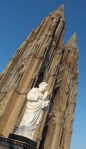
The other two photos are – The beautiful neo Gothic St. Philomena’s Church in Mysore – temple and mosque colocation near the Mysore central market.

Luckily Forgot My Cheque Book – but an afternoon at Le Salon Retro Mobile in Paris was a mind-boggling treat.

There was open access to the auction room where classics were under the hammer by Artcurial but I just missed seeing the 1957 Ferrari 335 Sport Scaglietti which became the world’s second most expensive car when sold for 32,075,200 Euros; who the hell increases a bid by 200 Euros when they are bidding in millions?

In the main hall there were dealers from all over Europe with a staggering selection of very expensive machinery; the DB5 Aston Martin was not for sale but every other taste and budget was catered for. The latest trend in France is called “Les Youngtimers” which includes lots of cars of the 70s for people who are becoming collectors on a very small budget – the Renault 205GTI is a new cult favourite but also the Alfa Romeo Alfasud (which I used to own and wish I still did), even the Citroen CX Break. Got to start somewhere.

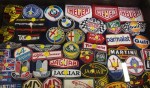
The other aspect that stood out for me was the number of factory displays; the big manufacturers displaying their museum examples alongside their newest models to show a tradition of innovation or sporting success. Maserati, Mercedes, Renault, Peugeot, Land Rover, Porsche all had huge beautiful displays and most of them were boasting of the availability of factory parts to maintain their classic fleet.

Photos: Aston Martin DB5, 911s of many colours, Pinin Farina PFX, Maserati factory stand, Badges, Ferrari Testarossa sold for $140,000. Triumph TR250 with two year warranty?

Muddy Ranch – An Amazing Story

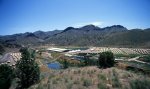
Returning to Portland from Mitchell, there is a lovely dirt road short-cut from the Painted Hills to Antelope via the Muddy Ranch which has played a fascinating role in Oregon’s history.

Prineville Land and Livestock Company

The federal government poured troops into the area to pacify it for settlers and ranchers in the 1860s, and the 70,000 acre ranch had its heyday in the early 1900s when it supported large herds of sheep and cattle that roamed the Ochocos in summer and wintered at the Muddy Ranch. For a few years more wool left Shaniko rail depot than any other station in the world. This all came to an end in the 1950s when the summer range was sold, the land became overgrazed, the ranch was put up for sale, and the nearest town, Antelope, hit hard times.

Rajneeshpuram – Five year story that beggars belief.

In 1981, the ranch was bought for $5.75M by the Bhagwan Shree Rajneesh and his cult. They planned to establish an “intentional community” and in three years turned the dusty valley into a city for 7,000 people; a city in the desert with townhouses, police, restaurants, a bus system, sewage plant, and a 4200-foot airstrip. Adherents flocked to the town, sold all their worldly goods and donated them to the Rajneesh who became famous for his huge collection of Rolls-Royces.

What the Rajneeshees did not do, however, was pay attention to any of Oregon’s land-use laws and were immediately embroiled in a conflict with their neighbours over what they were building. Bribery that would have worked in India did not work with local officials or 1000 Friends of Oregon who led the effort against Rancho Rajneesh and the cult then resorted to bio-terrorism, armed conflict, and arson against their opponents. The investigation into the bizarre array of criminal activities was the largest in Oregon history and eventually led to jail for many of the leaders and extradition of the Rajneesh to India where he continued to teach until his death in Pune in 1990. Ironically the Oregon Supreme Court eventually held that the incorporation of Rajneeshpuram was legal under Oregon law but this came too late for the cult that was, by then, broke, dispersed, or in jail.

Young Life – One religion replaces another

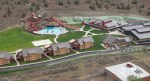
In 1991, the ranch was bought by the Dennis Washington family who failed to make a go of farming there and in 1999 it became the home a Young Life Christian camp with support from the Washington Family Foundation. Young Life was started in Dallas, Texas in 1941 by Presbyterian minister Jim Rayburn and now operates globally.

Unlike the Rajneeshees, Young Life recognised the need to engage the local community and, perhaps because of more closely shared values and beliefs, succeeded in getting Oregon law changed to allow their large scale residential operation on land previously reserved for ranching. In 2013, the Oregon legislature passed HB3098 that “Authorizes establishment of youth camp on certain lands zoned for exclusive farm use in eastern Oregon”. End of problem.

Then and Now

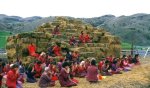
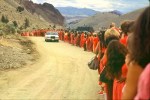
Looking at the photos of the Rajneeshees and the young Christians it’s hard not to conclude that there really isn’t that much difference in what they are trying to do – proselytise, harvest souls, spread their gospel.

The Rajneesh was asked for his Ten Commandments and, though he said he was against any kind of commandment he came up with a list “just for fun”. 

Personally, I prefer these to the ones being taught at Muddy Ranch today.

1. Never obey anyone’s command unless it is coming from within you.
2. There is no God other than life itself.
3. Truth is within you, do not search for it elsewhere.
4. Love is prayer.
5. To become a nothingness is the door to truth.
6. Life is now and here.
7. Live wakefully.
8. Do not swim—float.
9. Die each moment so that you can be new each moment.
10. Do not search. That which is, is. Stop and see.

Further Reading.

Excellent recent story in The Oregonian – http://www.oregonlive.com/rajneesh/index.ssf/2011/04/part_one_it_was_worse_than_we.html
Young Life – https://en.wikipedia.org/wiki/Young_Life
Rajneesh biography – https://en.wikipedia.org/wiki/Rajneesh
Washington Family Ranch today – https://washingtonfamilyranch.younglife.org/Pages/default.aspx

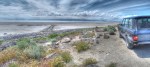
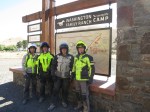
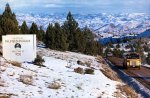
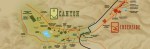
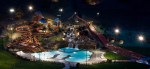
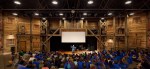
Photos. Our group riding through – Rajneeshees in meditation, Welcome to Rajneeshpuram in winter, Rajneesh daily drive by, Rajneeshpuram tented town for a gathering of faithful (From the Oregonlive story) – Welcome to Washington Family Ranch – Creekside today with dorms, water park, and sports centre, Map of the two sides to Young Life camp  (From affiliated Young Life websites) – Water park and interior of a meeting hall (From the website of the architectural design firm)