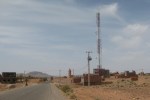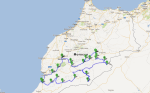
The Atlas valleys; 500 kilometers and 500 years from Marrakech ….. as we traveled across the High Atlas from Marrakech past Ouarzazate to the south, we entered the Great Oasis Valleys and moved back in time.

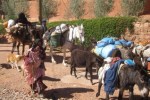
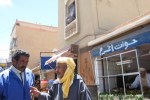
Even though we had continual 3G cell service for the entire trip, we encountered people living lives that had not changed in centuries. Leaving Dades we came across a Berber nomadic family moving along with their entire lives on donkeys, horses, and camels – clothes, tents, food, and flock being moved to a new resting spot. I really had the impression that Mary showing up in Bethlehem would have recognised this scene.

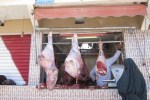
In Igherm, we arrived for lunch on market day and this butcher’s shop was typical of the street and next door the fish merchant was frying herring.

In Taroudant, the Berber Market was a maze of stalls selling everything imaginable under one roof – this one had spices and sweets with all the local ladies clamouring for the best flavours and the best deals. A long way from Walmart but everything under one roof.

That evening, the walls of the Medina were the site of women cooling themselves with their children whilst the men drank coffee across the street.

These are not scenes for tourists. We were the only non-Moroccans in all of these places and for most of the week we traveled.

Morocco – where Muslim girls go to school. …….. Just back from a motorcycle trip around the southern parts of Morocco – a journey back in time. Over the High Atlas from Marrakech to Ouarzazate, along the Valley of the Kasbahs, through Dades Gorge and Todra Gorge, to Merzouga and the dunes, to Zagora the gateway to the Sahara – only 52 days to Timbuktu by camel – back through the foothills to Tafraoute, the coast at Aglou-Plage, and home via Taroudant with its markets called the mini-Marrakech, and the Tizi-n-Test pass back over the Atlas. Overall a walk on the wilder side of Morocco.

Morocco is a Constitutional Monarchy with an elected parliament and King whose Alouite dynasty goes back to 1669. On paper this is like the UK, but Mohammed VI has vastly greater powers than Elizabeth II – he can dissolve parties and act by fiat. One the whole, however, Morocco comes across as a relatively peaceful and contented place; yes, there was a bomb in Marrakech but there has been no Arab Spring here and the place, at least city life, appears modern and relaxed.

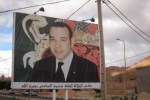
The King’s enormous posters can be seen everywhere but the cell tower is taking over from the minaret and I was struck every day by the fact that girls go to school in every place we visited – a rarity in a 99% Muslim country. The people we spoke to and drove alongside were gentle, helpful, and courteous and went to great lengths to emphasise that they were mainly Berbers whose traditions and history pre-dated any Arab invasions.

The Salton Sea – the first man-made eco-disaster …. The Salton Sea is a 500 square mile lake an hour south of Palm Springs. For 3 million years, this area was the delta of the Colorado River and formed the northern end of the Sea of Cortez. Eventually the delta extended far enough west that this valley was cut off – no water in – no flow out. For the last few thousand years the area has been alternately a dry desert basin or fresh water lake depending on rains.

Until 1900 when human ingenuity, hubris, and stupidity managed to screw things up on a monumental scale.

The idea was simple – send water from the Colorado into the dry lake for irrigation. Water + fertile land = crops + money + jobs + pursuit of happiness. What could go wrong?

Well, two years into the project the canals silted up and, in 1905, rain and snowmelt overwhelmed the headgates sending the whole volume of the Colorado River into the Salton Sink. This flooding continued on and off for thirty years until the Hoover Dam was completed in 1935 and got the Colorado under control. In the meantime the Salton Sea had been created. Today the inflow and evaporation are almost in balance and the sea is here to stay.

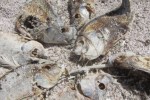
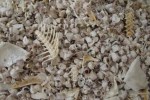
On a quick visit this week, we were amazed to find that the beach is entirely made of dried up and ground up sea creatures – barnacles and fish. I can imagine thousands of years of flooding and drying cycles leaving layer after layer of dried up crustacea. It looked like your plate after a million years of bouillabaisse dried out. Today the salinity and algal blooms contribute to regular waves of dead fish on the beach.

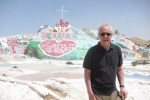
Along the eastern shore of the Salton Sea is Salvation Mountain – a massive sculpture about 50 yards wide by Leonard Knight made from local adobe clay and donated paint. One man’s Lord’s Prayer. This is an unbelievably unforgiving desert environment in which to spend 30 years on a work of art.

Everyone has their own Utopia.

Namibia is like Arizona until you hit an Ostrich …. The geological forces that created Namibia are not that different from those that formed the southwest USA. Sedimentation, retreating oceans, huge forces of tectonic plate movements followed by the relentless erosion by wind, heat, and water. Run this playbook for a few billion years at similar latitudes and you get similar results. Dry rocky deserts, craggy plateaus and mesas, dunes, boulders, and grand canyons.

But Namibia is not New Mexico. The animals, plants, and bugs have co-evolved very differently. The human story has been driven by different effects of tribes, food, conflict, colonisation, and different societies and values have emerged. This is why we travel – to see and learn about the world.

Before I finally close the diary on this trip here are some other views of Namibia.

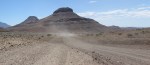
First the roads. The huge majority of roads in Namibia are not paved. This is a typical C road heading south out of Fort Sesfontein; theoretically flat and well graded dirt but the reality can often be very different with deep sand, invisible dips into rocky creek beds, and strange cambers. An environment, trust me on this one, that is unforgiving of lapses in concentration.

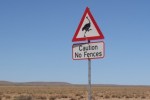
We saw road signs warning of all sorts of animals but we saw ostrich all over the place from the beach at the Cape of Good Hope to the deserts in northern Namibia. These are huge, ugly, and dangerous birds. When you see them poop, you are glad they cannot fly. If you were unfortunate to get close to them, they do not attack with their beak but with their strong legs and lethal claws. Come across a group of them and it could be a bad scene from Jurassic Park.

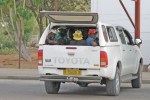
Public transport in rural Namibia is non-existent. The people we saw hanging about seeking the shade of a road sign, were waiting for a ride in whatever vehicle they could. This ubiquitous Toyota Hilux pickup at Khorixas had six guys hitching in the truck bed.

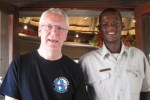
Finally meet Calvin who looked after us impeccably at the Mowani Mountain Camp. Calvin works for one month straight with no days off then he has six days to head home to his village to see his family. His village is a hundred miles away and he hitches a ride. If a ride doesn’t come along, he told us that he would sleep at the side of the road and try again the following day so his six day leave might only give him one day with his family.

Different lives.

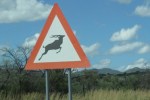
Three Views of Kudu …. Driving around any part of the world, you will see the international red triangle that signals WARNING. In Namibia we passed triangles that alerted us to Ostriches, Penguins, Elephants, and Warthogs; all you would agree would be bad things to run into. But, by far, the most common warning sign was this one telling us to look out for the Greater Kudu.

Kudu is a species of antelope – a browser that eats shoots and leaves and lives and hides from its predators (big cats and hyenas) in thickets that line every highway in open country. In the morning and evening they are skittish and are prone to leaping in front of traffic when disturbed. These are big animals – the males reach 700 pounds and are about 5 feet tall at the shoulders. When they are scared, they leap so when cars hit them they do so at windscreen height – not unusual for them to end up through front and rear windscreens.

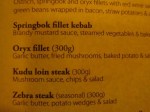
Perhaps this behaviour could explain why we ate Kudu so often on this trip – high end road kill or, as Mike Meyer, suggested “Kudu: the filet mignon of game meat”.

Delicious for sure.

** The menu was in Joe’s Beer House in Windhoek – http://www.joesbeerhouse.com – and the live Kudu was in the Etosha National Park – http://www.etoshanationalpark.co.za No visit to Namibia could be considered complete without visiting these two institutions.

Etosha National Park Namibia ….. No visit to Africa would be complete without a drive through a game park to see our favourite animals in their natural surroundings. Etosha National Park occupies 22,000 sq kms (about half the size of Switzerland) in northern Namibia and is home to hundreds of species of animals including several endangered species like the black rhino. We had the chance to be able to drive around on our own in rented 4x4s when the park was all but deserted by tourists and had the opportunity to get so close to these animals.

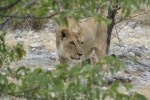
The highlight was undoubtedly the chance to see a lioness track an impala. We came across the lioness quite close to the road in a prone position downwind of two black-faced impalas which were innocently grazing and getting closer and closer to the big cat. She rose a couple of times to get ready to pounce but they did not get quite close enough. In the end they sensed their danger and scooted away. The lioness, realising that they were not now going to be dinner, ambled off, totally oblivious to our presence no more than ten feet away. When she got to the nearby watering hole, every other beast noticed the arrival of the alpha-predator and skiddaddled or kept undivided attention on the lioness.

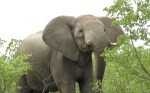
Earlier we almost ran over an elephant crossing the road and had a chance to get in front of it as it trampled and munched its way across through the trees. When I stopped the truck and stepped to the rear for a better photos (definitely against the rules) I was less than 20 feet away and stimulated the very clear territorial behaviour of spread ears and shaking head and trunk that definitely said it was time for us to leave.

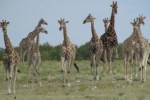
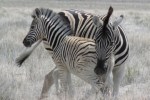
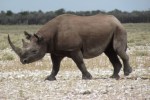
The black rhinoceros appeared from the trees as we stopped at a watering hole that was mobbed with oryx, springbok, zebra, jackals, impalas, and ostriches. He just kept on coming and presented us with a beautiful view of this elegant monster. We saw thousands of zebra including this mother that was still suckling and protecting this very large offspring. We visited a waterhole at the end of the day and saw a large posse of giraffes that were waiting for a herd of elephants to clear out of the way before they descended to drink.

The day was totally amazing and we saw too many other species to include photos here – spotted hyenas, hartebeste, wildebeste, impala, springbok, ostrich, warthogs, jackals, kudu, steenbok, bustards, secretary birds, mongoose.

What an outrageously fun day.

Herero Tradition and Genocide.

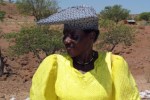
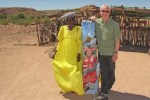
In 1883, the German land owner Adolf Luderitz arrived in what became German South-West Africa and swindled the local elders out of land. This led to conflict, which led to war, which led to genocide. By 1904, the German colonialists had wiped out 65,000 of the original 80,000 Herero people and similar numbers of Damara. Yet during this period, the ladies of the Herero and Damara had taken to wearing the long formal dresses of their German occupiers’ wives and this tradition continues even today. The headwear is made in the form of a cow’s horns – a symbol of great wealth to a people with a long tradition of pastoralism and herding.

The lady in the yellow dress was at the side of a very remote road with her daughter selling dolls and trinkets that showed their now traditional dress. The lady in blue was shopping with the help of her grandsons at a small market in Khorixas on our way to the Etosha game park. In very squalid circumstances these ladies are immaculately turned out and appear very proud of their dress and standing.

Pride is very important.

Here is a link to a book by the photographer Jim Naughten on the Herero people and their costumes – trendland.com/jim-naughten-herero-tribe-series-namibia/#

Wildlife in Africa. We have been heading north through Namibia and will soon spend time in the Etosha National Park where we hope to see the big guys – lions and cheetah and rhino and elephant and all that. But, in the meantime, there has been lots to keep us interested.

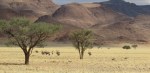
We have passed herds of Oryx with their stunning long straight horns like two pronged unicorns. Seen the beautiful and elegant Springbok roaming and, on occasion, leaping magnificently across the road to avoid our entourage of bikes. We have seen Wildebeste, Kudu, Ostrich and eaten most of the above on more than one occasion.

Here are also a couple of sights that have amazed me completely ….

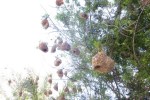
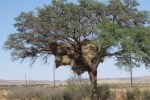
First the Sociable Weaver birds that made this enormous nest. These are the largest structures made by birds and are permanent structures for more than a hundred pairs of multiple generations of birds. Each pair has its own chamber and there are shared areas for roosting and for getting shade during the day. The nest here in this photo is about 15 feet across and 10 feet deep. Why these birds decide to share the task of home building but another species, African Weaver, decided to go it alone, I don;’t know – maybe they should be called the Anti-Social Weaver. The nests in this photo are right outside my room in the courtyard of the Fort Sesfontein Hotel.

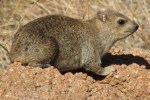
Then there is the Rock Dassie – the furry guy here is about 18 inches long and seems to move like a rabbit. This one was cruising the ground of Mowani Mountain Lodge. Looks totally ordinary but the ancestors of this little guy (properly the Rock Hyrax) evolved in several different ways – one branch ended up looking like this – like a big rodent – but others took to the water and begat ….. get this …. elephants (pachyderms) and dugongs and manatees (sirenians). So this guy’s nearest relative is the elephant. Amazing.

Africa is Huge.

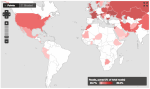
Riding through Namibia it is necessary to put things in some perspective – the country is over three times larger than Great Britain but with only two million people. Namibia has a GDP of $12B which is about one month of Apple’s revenue. Most importantly for the purposes of the group I am riding with, Namibia is a country with one the lowest percentage of paved roads in the world. Bottom line: If you want to find somewhere that is empty and has lots of fascinating areas to explore on dirt roads, this is your place.

It is also impossible to think about Africa without seeing it through the lens of European colonialism. Every inch, tribe, and tract in Africa was grabbed by one of a few European countries in the so-called Scramble for Africa from 1870 to 1914. The boundaries of all the modern African nations were decided in Lisbon, London, and Paris and ratified at the Berlin Conference in 1885. In this short period these places moved from an indirect dominance through economic or military influence to a full-on direct rule and colonial control. This allowed these countries, including my own, to grab resources to feed their factories and to fights wars with each other in Africa instead of doing it at home. That didn’t last of course and the whole process was reversed after World War II.

In Namibia’s case it was grabbed by Germany in 1884 after one of Germany’s elite, Adolf Luderitz, called for help when he fell out with the locals. Thus Germany was embroiled for 30 years in a guerilla war during which time they committed genocide of the two main tribes and setup a segregation system that was a template for apartheid. After the First World War, the League of Nations gave the mandate for Namibia to South Africa which they only gave up after their embarrassing defeat in the war with Angola. Namibia has been a stable, independent democracy since 1990.

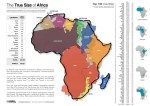
The graphics here show Africa as carved up by Europe, the size of Africa if you plot on a consistent scale, and the countries of the world ranked by the percentage of their roads that are paved. Who knew this data existed?

The Fish River Canyon in the southern part of Namibia is the second largest canyon in the world and is called “Africa’s Grand Canyon”.

In the main photo here we see Jim Hyde and Mike Meyer coming down along the canyon rim after we all rode up to put ourselves and our bikes in ridiculously dangerous photogenic spots at the canyon’s edge. It really is quite a wild and open place – a visitor centre and viewing platform that has sensible fences but just a few yards away there is nothing. A spectacular place to ride and explore.

We are well and truly into Namibia now – one of the least densely populated countries in the world. Nothing for miles. For large stretches we could imagine ourselves in any semi-arid desert environment, like riding in Death Valley, and the temperatures have topped 100F every day. Every stop we drink heavily to avoid dehydration and then pour water inside our riding suits so the evaporation gives the next best thing to air conditioning.

But just when you think you are in Arizona, you see Oryx or Springbok by the road and warning signs to avoid the Ostriches – apparently they do not attack by pecking but by slashing with their very sharp feet that can do a lot of damage to careless humans. Yesterday we ate Ostrich kebabs and Kudu for dinner – like venison with big curly horns and very tasty and low fat.

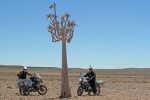
The tree is a Quiver Tree; a species of aloe that is indigenous to Nambibia and the Northern Cape of South Africa.