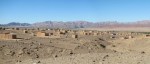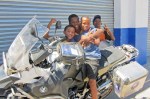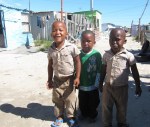
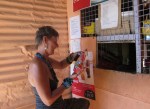
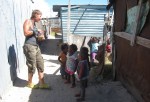
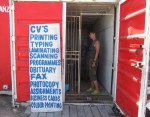
Khayelitsha is a township of two million people outside Cape Town, South
Africa.

I had the pleasure of being able to visit with Jenny Nomvoya Housdon who
works to raise awareness and help the people of Khayelitsha. Jenny showed
me the home of her adoptive family and we walked around, chatted with the
people who were there during the day, and gave the kids sweets. Jenny
showed me the metal building she and others have acquired to build a
pre-school. Most people here live in shacks made of corrugated metal – some
have “formal” arrangements for water and electricity but most “informally”
get electricity through connecting to the overhead cables and get water
through communal taps. The conditions are inconceivable for most of us but
I was surprised to hear that many people who could leave, don’t –
preferring to stick with the community and family. I learned so much about
life here in a very small time and I’m grateful to Jenny for the
opportunity and the patient explanations.

Racial segregation has been a fact of life in South Africa since colonial
times under the Dutch and the British. The intellectual ideas of apartheid
began to be formed and rationalised in the 1920s and 1930s – take a large
helping of white belief in their destiny to control and improve the world,
add a huge dose of exposure to National Socialism and the Nazi thinkers,
mix in a healthy dose of financial and business self-interest, blend with
support from the Dutch Reform Church, bake for a couple of centuries and,
voila, you have a fully formed but totally unworkable doctrine. All of this
became official government policy with the National Party electoral victory
in 1948.

Just as the rest of the world was heading to de-colonise and reverse
discrimination and domination, South Africa headed aggressively in the
other direction. All citizens were categorised by race and land was
segregated by forced removals of over 3 million people. Non-whites were
disenfranchised in 1970 and blacks deprived of their South African
citizenship; being made citizens of ten “homelands” based on tribe. All
services were segregated and, needless to say, blacks did not get the same
services as whites.

But of course the whole edifice was a farce – you cannot put all the black
people in homelands if you depend on their cheap labour to run homes,
farms, and factories in the white areas. The townships were a compromise to
keep labour close to work that whites did not want to do – and still do not
want to do. The whole edifice crumbled in the 1980s and President De Klerk
released Nelson Mandela and they both steered South Africa away from a
possible civil war to democratic elections in 1994. This was truly a
miracle given the built up hatred.

It would be easy to categorise the townships as just the ugly residue of
apartheid and unique to South Africa but it’s not as simple as that. For
sure, there are a lot of people here whose life has not changed much since
apartheid but every country in the world has large numbers of people for
whom there is no work and little in the way of prospects – favelas and
shanty towns and slums in Sao Paolo, Mumbai, Nairobi. At least here the
government seems to recognise a responsibility to do something and appears
to be trying to help.

Every other Africa country that was released from colonialism seems to have
gone the same way – new leaders promise to create a socialist Utopia, get
elected and realise how impossible that is, then settle for stealing the
country’s resources for their clan and family, then they never leave.
Taylor, Mugabe, Kabila, Daniel arap Moi, Idi Amin, Kagame, Abasanjo – the
list is endless. The fact that South Africa avoided this is truly
astonishing.

As for the townships? Not easy to imagine that these get wiped out any time
soon.
Norotshama Lodge is on the Orange River that forms the border between South
Africa and the southern border of Namibia. There are hundreds of acres of
vines that are drip irrigated from the river as there is negligible rain in
this lunar landscape and rocky desert. As you leave the town and hit the
dirt road, you see a bizarre collection of thousands of bamboo huts that
appear to have no inhabitants. These are apparently for the 15,000 migrant
workers that show up here for the picking season to work on the farms.

These boys are in Rosh Pinah, a diamond mining town in the far southwest of
Namibia. This whole corner of the country is completely off limits to
visitors and is essentially controlled by a single industry and a revenue
sharing deal between DeBeers and the Namibian Government. Just crossing the
border area on the dirt road along the river put us into a police
checkpoint that insisted on logging every vehicle and every person who
passed.

As we rolled up the main road towards Aus, our final destination for the
day, we saw all kinds of wildlife including Ostrich and these Springboks.

Cape of Good Hope

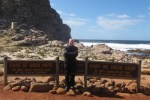
Was the first stop in our Africa riding tour. Originally called “Cape of Storms” by the Portuguese explorer Bartolomeu Dias in 1488 on his way looking for spice routes. This is not the most southern point in Africa but the symbolic point where navigators turn to head east for their real objective. At the time, nobody was interested in actually stopping and settling the Cape as everyone was too busy trying to get to India and valuable spices. It was not until 1652, when Jan van Riebeeck established the the Dutch East India Company’s resupply station on Table Bay; now Cape Town.

Along the way we started our encounters with animals you don’t see too often – road signs that said “Caution Penguins on Road”, Baboons in family groups, and Ostrich grazing at the Cape.

The panorama is of Hout Bay, a suburb of Cape Town really – just one of the stunning vistas as you ride around Cape Peninsula.

Finally ended up in Lamberts Bay, couple of hundred kms north of Cape Town, and one of the most amazing dining experiences you could ever imagine at Muisbosskerm – an open air restaurant, walled with a thatch of thorn bushes, cooking an astonishing, non-stop buffet of seafood where the only “silverware” is a mussel shell. Worth the flight for this restaurant alone – www.muisbosskerm.co.za

Finally here are Ron Ayres (L) and Jim Hyde ®, the organisers and co-conspirators for this trip.

The Next Couple of Weeks

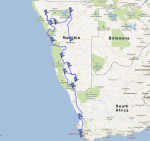
I signed up with Jim Hyde and Ron Ayres’ combined little Discover Africa ride – Cape Town, South Africa to Windhoek taking in most of Namibia. All in all about 2,500 miles, mainly to places with dirt roads or no roads. Ron has promised that we will be “Dusty by Day: Dazzled by Night” so I assume I’ll be able to connect periodically and send photos along the way. Watch this space.

In preparation, to get my brain into Africa, a continent I have not visited before, I have been hitting the books and these are the highlights so far; hugely enjoyable whether you are heading for Africa or not. These are stories of extraordinary people in extraordinary times.

Into Africa by Martin Dugard – how Stanley met Livingstone and their fascination with Africa. Two Englishmen guided by very different histories and spirits but both drawn to Africa and adventure at the dawn of the European scramble for this continent.

West With The Night by Beryl Markham who grew up from the age of 6 in what is now Kenya. Spent life as a kid on the loose with the Masai, trained and bred horses, learned to fly and spotted elephants for Karen Blixen’s husband, and was the first person to fly the Atlantic solo from East to West. An interesting enough life but here is what Ernest Hemingway said about her in a letter to a friend … “Did you read Beryl Markham’s book, West With The Night? …She has written so well, and marvellously well, that I was completely ashamed of myself as a writer. I felt that I was simply a carpenter with words, picking up whatever was furnished on the job and nailing them together and sometimes making an okay pig pen. But this girl, who is to my knowledge very unpleasant and we might even say a high-grade bitch, can write rings around all of us who consider ourselves as writers … it really is a bloody wonderful book.”

The Mind of South Africa by Allister Sparks – tracing apartheid from the landing by the Dutch East India company at Cape Town in 1962 to the release of Nelson Mandela in 1991. An astonishing tale and a brilliantly written book.

Nobel Square and Coca-Cola Dude?

The V&A Waterfront in the centre of Cape Town is the scene of significant gentrification around a working harbour. Upscale shops and apartments and restaurants sit right on top of a stinking fishing fleet and the whine and clatter of ship repair in the dry docks just outside my hotel window. Think London Docklands but with the actual docks still there.

Into this insert a site to honour four South African winners of the Nobel Peace prize – Chief Albert Luthuli (who could not get to Norway to accept due to travel restrictions in 1960 because of the Sharpeville Massacre), Archbishop Desmond Tutu (who ran the Truth and Reconciliation effort after the end of apartheid), and former presidents Nelson Mandela and FW de Klerk (who worked together across the race divide to scrap apartheid and move on without the bloodbath that accompanied so many other revolutions)

Both this testament and the waterfront are both beautifully done with Table Mountain as the essential Cape Town back drop.

But then WHY, for goodness sake, build a statue of a dude out of Coca-Cola cases right in the middle? What on earth were they thinking?

Apples Don’t Fall Far From The Tree

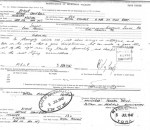
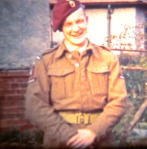
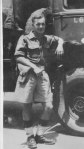
After looking with my sister at a few photos of my Dad during his military service and realising that we knew very little about his service, I wrote to the Army Personnel Centre to ask for a copy of his records. There are still more unanswered questions but the almost illegible handwriting over five years of dozens of clerks using unknown acronyms has revealed a few things we did not know.

First the overall timeline:

– Arthur Campbell Evans joined the Royal Signals in June 1942 from school at the age of 18 and was sent to Catterick Camp in Yorkshire for basic training before being posted to a battalion in February 1943. He was then sent to the Reserves and back to school in April 1943 “for the purposes of Engineering Cadetship Studies at Rotherham Technical College”.

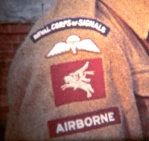
– Then “rejoined the colours” in April 1944 and was accepted into the 6th Airborne Division, the Parachute Regiment or “Red Berets”, in August 1944. Shortly afterwards he was injured in training and admitted to hospital from December 1944 to May 1945. Very little was ever discussed about this but must have been fairly serious.

– In the Autumn of 1945, he embarked for the Middle East – Israel as part of the force charged with the British Mandate in Palestine and he served in Jerusalem, Haifa, and Tel Aviv. He was promoted to Corporal in May 1946 and was then embarked back to the UK and demobilised in September 1947. The British presence in Palestine ended with the Israel Declaration of Independence. the 1948 Arab-Israeli War and all that followed.

His release described him as “A thoroughly reliable NCO, well above average intelligence and keen on his work. Not a good disciplinarian, but can make a good team out of the right men. Very likable personality, and cheerful in the most trying circumstances”. When I left Intel I said that I had 29 years with the same performance appraisal but now I realise that my review and my Dad’s were also essentially exactly the same.

If you want to learn more about the “most trying circumstances” that the British Paras encountered in Palestine you can read about their work below; essentially the same experience as troops who have more recently served in Iraq and Afghanistan. Just another group of terrorists shooting at us who hope to be remembered one day as freedom fighters.

http://en.wikipedia.org/wiki/6th_Airborne_Division_in_Palestine http://en.wikipedia.org/wiki/The_Sergeants_affair

The Shuttleworth Collection.

I had a chance to visit the Shuttleworth Collection at Old Warden today. This is a must-see aircraft museum with dozens of flyable classics back to the 1909 Bleriot XI, the world’s oldest aircraft still flying, up to the icons of WWII. Every one of these is in immaculate condition and I would highly recommend getting to one of their flying days. Alas today was freezing and snowing and none of these beauties was going to be exposed to the elements.

One or two caught my eye and here are some photos for you aeronautic fans and assorted gear heads.

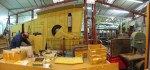
First, the restoration of a Spitfire which has been going on with mainly volunteer help since 2007. The wing and fuselage had been totally dismantled and stripped and repainted and were undergoing replacement of all 25,000 magnesium rivets which have become a corrosion risk. The fuselage looked like it was brand new and you can see every piece of the wing strung up on a clothes line waiting to be reattached.

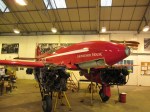
Then there was one of the most beautiful aircraft in the world, after the Spitfire of course, the DeHavilland Comet “Grosvenor House” which won the London to Melbourne air race in 1934 with a time of 70 hours; a record that stood until 2010.

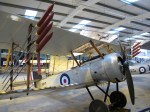
Finally the rocket launching system on this Sopwith Pup caught my eye; World War One meets Guy Fawkes Night.

Further reading:
DeHavilland Comet – http://en.wikipedia.org/wiki/De_Havilland_DH.88
Shuttleworth Collection – http://www.shuttleworth.org/shuttleworth-collection/aircraft.asp

Mirror in the Desert

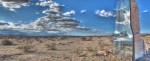
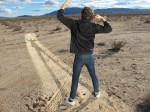
On a family drive from Palm Springs to meet an artist collaborator of Claire and Jona, we came across this mirage which tempted us to walk into the desert to investigate.

What we found was a mirror shaped to the chimney stack of a destroyed house. Nobody locally knew how it got there. The photographic possibilities were endless.

What’s in your brain at night?

Do you wake up in the middle of the night and struggle to get back to sleep because of the music playing in your head? I don’t mean your worsening tinnitus from too many hours listening to Led Zepp or the noise from the neighbour’s party; I’m talking about the song in your head that won’t let you get back to sleep.

Here’s my admission – last night it was Daryl Hall and John Oates. “You’re a rich girl, and you’ve gone too far. ‘Cause you know it don’t matter anyway. You can rely on … ” well you get the point. The same chorus and first verse over and over again.

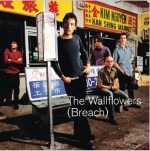
Couple of nights ago it was the guitar intro to The Wallflowers “Some Flowers Bloom Dead” followed by Jakob Dylan singing “We didn’t make it, We did not pull through. You shouldn’t blame me, I don’t blame you”.

The thing is, I don’t remember actually hearing these songs anywhere. They are not on my iPod Nano that I use when working out, and I doubt they were on NPR which is the only radio station tuned in the car. So where’d this all come from?

Calling Dr. Freud right now.

The Institute du Monde Arabe is a stunning building on Paris’ Left Bank. The glass tower has a elaborate high tech system of metal curtains to control the heat that work like thousands of camera lenses but arranged in patterns like the windows of minarets to create an infinite set of possible configurations. Fourteenth century meets twenty first century.

The role of the institute appears to be to promote cooperation and promotion of Arab culture and values in France. As part of that, the top floors house a beautiful and minimalist museum of Arab history that is the most politically correct place I have ever visited. Every display on the Arab role in the history of science, art, language, and religion is walking on egg shells trying to be clear on the historic leadership of the Arab world without sounding provocative. The descriptions of all the exhibits appeared to have been written by committee and are practically unintelligible.

It gets most tricky when discussing religion of course. Arab identity can be traced back 3000 years so Arabs clearly pre-date Christianity but also pre-date Islam. Even though today most Arabs are Muslim, there have been Arab Christian and Arab Jewish states. The Museum respectfully discusses the three main religions to come out of the Middle East but then says that, though the Koran appeared later than the Bible or the Torah, it is really the word of God expressed through the Prophet so the history doesn’t matter.

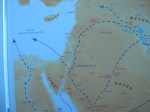
They also go to great lengths to make sure visitors understand that the word “semitic” is used to describe a group of languages from which both Arabic and Hebrew come, and is not a racial grouping that is unique to Jews or a political description of Israel. Along those lines though, it’s interesting that the map at the entrance of the museum that shows the Arab countries and their neighbours, does appear to be missing one. Political correctness only goes so far it seems.