

Georges Cuvier.

When we think of scientists that changed our world view fundamentally and forever, Newton, Darwin, Galileo, Einstein, and a host of others come to mind but we never learn about Georges Cuvier.

Cuvier was a naturalist in the early 19th century who worked to compare fossils with living creatures. He essentially created the fields of comparative anatomy and paleontology and established extinction as a fact.

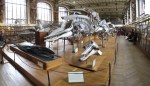
The Galerie de Paleontologie et Anatomie Comparee in Paris is a delightful place to visit to learn more about this field and Cuvier’s role and the place is visually stunning. The gallery was inaugurated in 1898 and does not look like it has had a coat of paint since. The place was built 70 years after Cuvier’s work and 40 years after Darwin published Origin of Species but the links are all clear.

There is also a small homage to Cuvier in the history building where it is possible to see his original notebooks and specimens and humble observations. “a veritable history proved by the monuments that anyone can consult and where everyone will read them like me, but they make just a tiny fragment of the huge history of the world”.

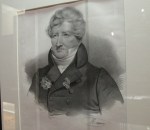
Cuvier’s bust is at the head of the whale skeletons. Interesting that the embarrassment of the human form is prevented by a strategically placed fig leaf.

More on Georges Cuvier http://en.wikipedia.org/wiki/Georges_Cuvier
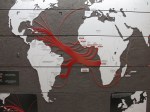
Memorial to the Abolition of Slavery

In Nantes there is an almost invisible but moving and eye-opening memorial, built into the quays along the Loire, to the abolition of slavery. The memorial is deliberately intended to help Nantes come to terms with its past as the largest home base for slave trade boats from France, “le premier port negrier”, so it could just as easily have been installed in Liverpool or Boston. The timeline and display shows both the statistics of the 18th and 19th century slave trade as well as the history of the movements to abolish it.

Having been brought up in Great Britain and having lived for over twenty years in the US, I had always thought of this trade as an essentially British and American affair; the traders of the Empire making sure that their ships were always filled with the most valuable cargo and ensuring that the new colonies had the labour needed to prosper. I had also seen abolition as a similarly anglo-centric narrative; William Wilberforce campaigning tirelessly in Parliament and Thomas Paine and John Jay starting a dialogue that led to the Civil War in the United States.

But the graphics in this memorial tell a much more complete and awful story. In total around 12 million slaves were shipped from Africa and it is impossible to know how many people actually died before they got to the ports or who were killed in the process of capture. The majority of these came from Central West Africa (today Angola and Congo) and the rest from what is today Ivory Coast, Benin, Nigeria, and Cameroon. Of those 12 million who left, it is believed that maybe 10 million arrived in the Americas.

What totally amazed me was the distribution on the other side. I had always assumed that the US colonies were the major recipient but they “only” took around 650,000 slaves – maybe 6% of the total. The huge majority, probably over 3 million, went to what is now Brazil. Millions more went to the European colonies in South America French Guyana, Dutch Surinam, British Guyana, and Spanish Venezuela. Then Cuba, Jamaica, and Haiti took about the same number as all the US colonies combined.

To put this in context. The 1850 population of the USA was 23million of which 3million were slaves. The 1850 population of Brazil was 9million of which 7million were slaves. Perhaps not surprisingly, Brazil was the last western nation to abolish slavery in 1888.

Details on the Nantes memorial
http://memorial.nantes.fr/

Abolitionism
http://en.wikipedia.org/wiki/Abolitionism

Slavery in Brazil
http://en.wikipedia.org/wiki/Slavery_in_Brazil

Slavery in America
http://en.wikipedia.org/wiki/Slavery_in_the_United_States

There isn’t an App for this.

It is easy to get blasé about your experiences in life and find it harder and harder to be truly impressed, but the Steens Mountains in Eastern Oregon possess the ability to blow your socks off.

In fact, nothing prepares you for the view from the East Rim Overlook.

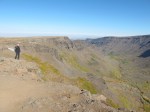
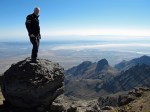
After a twenty mile dirt road ride from the Frenchglen Hotel, you have climbed from 4,000 feet to almost 10,000 feet in altitude without seeming to notice the slope, passing aspens changing colour and staring down into the Kiger Gorge. Arriving at the parking spot for the overlook, still, all you see is a notice board. Then you walk the remaining fifty feet and the whole world falls away to reveal a mile deep drop to the Alvord Desert and a view to “infinity and beyond”, hundreds of miles to the east.

I defy you to take these few steps and not scream WOW over and over whether someone is listening or not.

If you are here on a motorbike that is capable of this journey, then there is no alternative to finishing the Steens Loop and dropping down to Fields, OR and then back north along the base of this escarpment and onto the Alvord Desert that you can see in the panorama view.

This is dry, mainly, lake bed about 8 miles by 15 miles with smooth clay – an irresistible proposition for anyone on wheels – motorbikes, cars, land yachts, and kiteboards all come out to play.

We are all better off doing plenty of things for which there ISN’T and App.

Finally home after a great ride across Oregon.

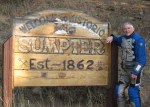
As I am traveling with Mick Sumpter, we had to visit Sumpter just outside Baker City. Then we took off across the Blue Mountains to Granite and Ukiah; out into the high desert cattle ranches around Heppner, then the wheatlands to Condon and Wasco.

Over two hundred miles of almost unblemished tarmac, practically deserted, essentially unpoliced; mountains, forests, and deserts without a straight road or freeway to be seen. The Nurburgring all day long. Superb. The total distance ridden to, from, and around Moab, UT from Portland was 2500 miles.

Just for fun, here is the journey on the same scale as the UK mainland. We essentially rode Lands End to John O’Groats three times.

Moab Long Canyon

On the last day of our little trip to Moab, we took the opportunity to ride up Long Canyon. From the Colorado River the trail winds up the canyon and climbs about 1500 feet to a fallen rock that makes a natural tunnel.

The views coming back are just stunning with monumental red rocks sculpted by wind, water, and ice into a landscape that is both playful and threatening.

Riding in Moab

Moab is at the centre of a spectacular area of red rocks – on the Colorado River and wedged between Arches National Park and Canyonlands National Park – and has a cornucopia of roads and trails.

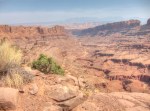
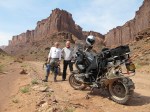
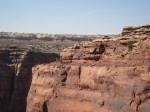
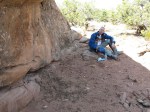
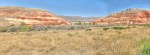
Here is a sampling of our experience this weekend. The panorama is a view of the Colorado River valley looking southwest towards Moab. The two photos of the red rock cliff are on a ride to Spring Canyon that takes you across the ledge that looks down into the canyon (that is me on the far end waving and the next photo is a blow up to prove it) After the ledge we rode around the end of the cliff and down to the canyon bottom on a series of switchbacks. The final photo is Mick under a lovely rock overhang we found to shelter from the sun for lunch.

The Mecca for Speed Freaks

So the journey to Moab from Portland continued from Frenchglen down into Nevada and along the most boring 400 miles of freeway you can possibly imagine. No photos of that my friends.

At the end of that nightmare, however, you end up in Mecca – The Bonneville Speedway – place of legend from Sir Donald Campbell (Bluebird 1935 at 301mph) to Andy Green (ThrustSSC 1997 at 763mph) Sorry to only mention the notable British attempts but they do seem to bookend several eras of racing here. If you have seen Anthony Hopkins in The World’s Fastest Indian, this is where Bert Munro set the 1000cc motorbike speed record in 1969 of 183mph that still stands.

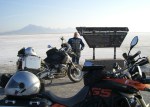
Anyway, we were not allowed to go chasing along the salt because the track was “active” so we settled for a couple of photo ops attached.

Oregon is a Wonderland

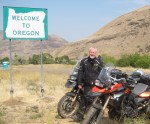
I’ve said it before but here we are again. I started a motorbike journey with my old friend, Mick Sumpter, from Portland to Moab, UT and cut diagonally across Oregon. From Portland across the base of Mount Hood – burst out of the forest to Maupin – across the Deschutes and into the high desert to Shaniko and then to Antelope – into the back country to the former Rajneesh compound – up and over on dirt roads into the John Day River valley – through the Painted Hills to Mitchell – from John Day to Burns through the National Forest – across Malheur Lake and onto Frenchglen and the Steens Mountains.

That is 400 miles – about the same distance as riding from London to Edinburgh – across a new eco zone every hour. An amazing place.

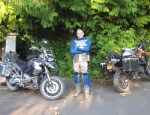
Photos – Mick and I all clean before we left, the Painted Hills, and the morning view from the Frenchglen Hotel across to the Steens.

Oregon’s got Talent … end Enterprise and Hardman.

As I was circulating around the Northwest these last couple of weeks, I noticed how many “Dictionary Towns” we passed. Not “Adjective+Noun” towns like Silver Lake or New Bridge or Christmas Valley but single word names that can be found in Webster’s.

A casual study suggests that these names appear to fall into two categories – FIGURATIVE, where the town has a description that appears to define its purpose or location and ASPIRATIONAL, whose name seems to call the citizens to a higher purpose or perhaps remind them of a reward in the afterlife.

We passed by Figurative towns like Halfway, Dairy, Hayfork, Fields, Bend, and Homestead and Aspirational places like Bonanza, Plush, Talent, Enterprise, or Prospect.

I found myself imagining that people from these towns must have a lovely time introducing themselves and starting a friendly conversation just by saying they came from Antelope, Drain, Spray, Gooseberry, or Fossil. And which guy would not be delighted to start his pickup line with “Hello darling. I’m from Hardman”?

California Coda

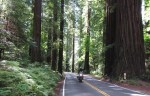
As we were in the neighbourhood, we decided to dive into California from our circumnavigation of Oregon. From Klamath Falls to Mt. Shasta, then across the Trinity Alps from Scott Mountain, alongside Trinity Lake and west to Fortuna. Then down and back along the Avenue of the Giants and up the Pacific coast to Crescent City and back up the Smith River to Grants Pass as we got back into Oregon.

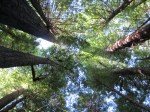
The Avenue of the Giants is well worth the trip – truly magnificent 30 mile drive through the massive redwoods – but the roads are motorcycle nirvana. Highway 3 over Scott Mountain, then Highway 36 across the mountains, and Route 199 up the Smith River are all non-stop curves and swoops – over the hills, tight through the redwoods, and stunning up the river valleys.

Every one a winner and the BMW GS bikes enjoyed the twisties like sport bikes, soaked up the bumps when the roads were bad, and let us get off into the woods when we saw the chance.