Ride into Lima – Last update from this trip.

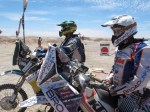
On Sunday we finally arrived in Lima by the same route as all the racers and there were thousands of Dakar fans lining the streets to cheer; like riding in a monstrous and unruly 4th of July parade.

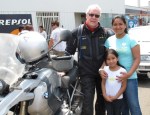
At our final fuel stop we had a mob scene of people wanting to get involved and be photographed even though most of them realised we were not real competitors; just gringo wannabees enjoying the palely reflected glory.

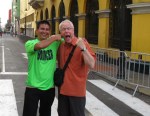
By the time we had dropped off the bikes, found the hotel, and made ourselves respectable – what my dad called “a shit, shave, and shampoo” – we had missed most of the Dakar celebration action at the Plaza de Armas but it was still quite a street scene; with the Dakar circus overlaid onto a normal Sunday in Lima where the centre of the old city is blocked to traffic and occupied by families in their thousands enjoying the evening air.

Every branch of the police and armed forces seemed to have been pressed into service for security around the Dakar but there were also dozens of “bouncers” manning the barricades. How did that word enter the Spanish language?

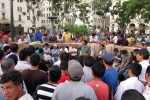
On Plaza San Martin, honouring the man who helped steer South American countries to independence from Spain in the early 19th century, groups were gathered to air their political grievances; everything from indigenous indian rights to education issues. This group surrounded a well mannered debate on the effects of western capitalism on the Peruvian food supply and the resultant effects on both economic independence and health.

So, there we are. Two weeks that seem to have flashed by. Three thousand miles from the Atlantic, through steamy Pampas, over the Andes, and along the Pacific through the dunes and cliffs in the world’s driest desert. We moved at a speed that meant we did not have enough time to stop and see and absorb everything we would have liked (as Jim said “it feels like we ran through the museum”) but our pace was dictated by the Dakar and it was wonderful to be swept along by the enthusiasm that everyone here clearly has for this race as it has expanded and settled in South America.

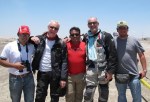
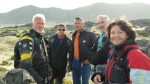
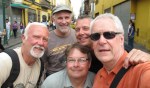
Everyone we came across was courteous and helpful and even the police seem to have received orders to behave. We were sorry to lose Gale along the way when she got injured but the group all got on well (L-R) Jim Hyde, who organised the whole thing, Charlie Walton, Michael Ruppert, Wim DeBruyn, and me.

Where are we going next guys?
The Ultimate Endurance Sport – Dakar on a bike.

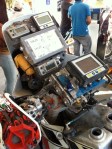
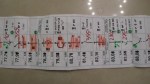
At the top of this update is a piece of the road book that is provided to each competitor as their only instructions on how to navigate the stage – this was “liberated” from a checkpoint where the riders were changing their maps.

There is no GPS satnav to help; just old fashioned time and distance and information on where to turn and what to avoid. This strip is then loaded onto a device like a Rizla cigarette roller and off they go. It is inconceivable to me how they all deal with both the physical demands of this race and the mental load of navigation and survival – the cars and trucks at least have a second person just dealing with navigation. For most of the stages they are trying to find their way in open terrain and not on existing roads.

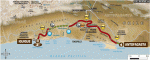
Stage9 that is shown here and in the video below is 566 Km with most of that in the dunes – that’s 350 miles. Imagine racing from San Francisco to Los Angeles – on the beach – every day for two weeks.

These are really superb athletes. It is amazing that about half of the starters actually made it to Lima though mechanical, physical, medical, and mental reasons all contributed to the attrition. The finishers medal is a real badge of courage and determination.

Take a look at the video from the Dakar organisation – just three minutes – www.dakar.com/dakar/2012/us/stage-9/videos-galery.html

Interaction with the locals

Everyone here in Peru is just thrilled to see the Dakar Rally come to their country. The headlines in all the newspapers talk about Peru in the eyes of the world and they all love it.

Every time we stop something happens and here are just a few examples from the cute to the bizarre.

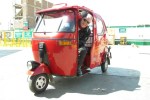
The driver of the red rickshaw – called moto-cabs – in Chincha was flattered by all the questions and let us all play at cab driver. This was a particularly solid and well maintained example but the dozens of these dashing in every unpredictable direction made riding in Peruvian cities a real chariot race. Undoubtedly the streets of Areguipa and Nasca have been the most dangerous riding we have done. Seriously.

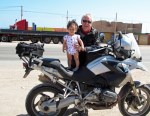
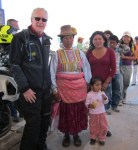
The three guys at the finish of the stage just wanted to be photographed with the gringos on big bikes who had come to visit. This happened a lot and was always done courteously wherever we went. People could not have been nicer regardless of country. On several occasions, ladies thrust their infants into my arms for a photo too. I am not too sure what this is all about – will the young lady one day be shown the day she met a tall darkly dressed stranger? Anyway, on each occasion, I make sure that the kid in question cannot fall from my arms.

Finally, when we arrived in Nasca, we were approached by a guy with a sack tied at the neck and offered a “pequeno zorro, cacherro de zorro”. Zorro? I’m old enough to remember that TV series but what is he selling? Well Zorro means fox and he had two fox cubs. I have no idea how he got them or what he thought anyone would do with one or how he expected gentlemen on motorbikes to make off with their purchase. Needless we declined and left sadder than when we arrived.

Jan 13th – Back into the desert

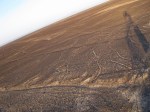
Leaving Nasca at dawn and heading north you have to stop at the tower to see examples of the Nasca Lines; a world heritage site of pre-Columbian geoglyphs put there by the Nazsca indians in the first few centuries AD.

There are miles of lines and dozens of pictorial images over a 100km distance of desert but the little tower only shows two of them. This is an acacia tree – upside down from this angle as the roots are in the distance the closer pieces are the branches. What are they – messages to the Gods and signals for religious ceremonies or communications to aliens along landing strips for when they arrive? Scholars disagree; so you decide.

We then went to see the start of the next to last special stage of the rally – whoever has it sown up today is the winner as tomorrow is just a small parade stage like the ride around the Champs Elysees for the Tour de France.

What you see here are:

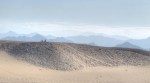
Two spectators who decided to keep their distance and stick to the long perspective

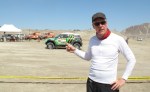
Stephane Peterhansel (302) sitting ready to blast into the desert – he is the race leader and today’s stage did not change that. Yes, this is a Mini and maybe one like this one will come to a showroom soon – 4WD and 3.6 litre turbodiesel – perfect for shopping.

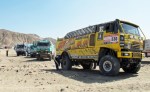
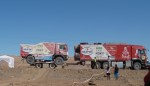
The first few trucks getting ready to race. Hard to imagine that these behemoths more-or-less keep up with the bikes on total time.

Jan 13th – Spectacular Riding

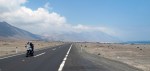
We got started too late this morning to be able to catch the Dakar circus but, as a result, we had an almost undisturbed day on one of the world’s most exciting motorbike roads; the Panamerican Highway from Arequipa, up the coast of southern Peru, and then inland to Nasca.

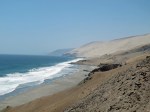
This is still in the Atacama Desert so for hundreds of miles the most arid place on earth is pushing up against the Pacific ocean. Extraordinary vista after vista after every turn and after every crest. Mountains and hills and plains of rock and sand but now with the blue colour contrast of the Pacific. Stunning beauty and an amazing road.

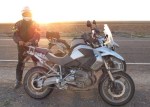
The 1200GS is the perfect bike for the road with power, torque, brakes and handling of a sport bike but tyres and suspension that absorb all but the most outrageous bumps. The Panam is generally very smooth and clean but some sections are in awful condition and really shake your fillings out after a while.

Guinea pig or llama? Delicious.

Here are a few of the food choices with which we have been presented on this trip.

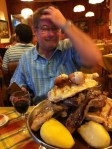
In Copiapo, Chile we went to a local restaurant called Munich and were served their customer favourite that translated to something like “Mountain of Meat”. As you can tell from the photo and Michael’s expression, they delivered on their promise. Steak, chicken, pork chops, intenstines, sausages and potatoes.

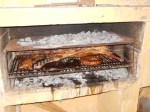
In Chilecito, Argentina we stayed in a family home that was a rambling set of rooms with their backs to the street and facing into the garden or courtyard. In one of the little gardens there was a traditional Argentinian barbecue. At the side is an oven in which wood is burned until it is in embers which are then slid under the grill and onto the top of a metal cover; great cooking idea for outdoors. In this case we see a chunk of beef, a few homemade sausages, and half a goat.

On the road, the fast food of choice is the universal empanada; folded pastry with various fillings that is then baked or deep fried. In this case Jim is enjoying a shrimp and cheese empanada at a truck stop in Chile.

Finally, in Arequipa, Peru we were treated to a number of local delicacies at a fantastic restaurant on a terrace around the magnificent city square with views of the cathedral on the other side. Here you see guinea pig prepared by roasting between two stones in a method that was supposed to be “pre-Incan”. No, it does not taste like chicken; it tastes like guinea pig.

One thing is certain, there has been a distinct overload of animal protein on this trip and an equally distinct lack of vegetables – no cooked carrots, beans, broccoli, and no soups – with a predictable effect on my body. I am not losing weight despite the serious daily exertion and I need to find some dietary fibre somewhere soon. That’s enough information on that topic.

Jan 12th – Arica, Chile to Arequipa, Peru

Arica is jammed up against and the border with Peru and it takes no time at all to get to the border full of expectation for a new and exciting day chasing the Dakar across the desert. It then took us almost four hours to get our bodies, bags, and bikes across the border. Forms filled by hand four times to get the bikes out of Chile and a similar byzantine set of processes to get into Peru. Apart from actually stamping our passports not one of these steps added any value at all and most of the officials involved seemed to have no idea why they were doing what they were doing. I remember when all of Europe had two customs and two immigration departments and a money changer at each border crossing but now all of this has gone away. Not so in South America and we wasted half our daylight.

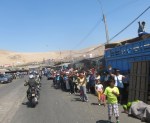
Our first encounter with real people, not in uniform, in Peru was at the town of Tacna where our route took us through the local market where all the other Dakar vehicles were supposed to pass. Even our little entourage was greeted with huge enthusiasm by the local folks. They are genuinely enthusiastic to see the circus pass through town and are really proud that Peru was chosen to be part of the Dakar. Everywhere we have been greeted with warmth and courtesy and I think that people are really pleased that somebody has found a use for this otherwise uninhabitable place. As we came into Iquique the other day we were greeted by both the army and the local nuns waving national flags and cheering on the Dakar competitors. Every day a bizarre experience.

We have now been riding up the Atacama Desert for four days and the terrain is still breathtaking but impossible to describe or photograph. Every time we climb a valley and crest the hills we are greeted by another 50km view of desert and hills and more sand and rocks. I have been trying to think of ways to relate to it all – but it’s not like anywhere else you have been. It has the colours of the Grand Canyon but there has not been for any rain here for hundreds, maybe thousands of years. None of the houses for a couple of thousand km have any gutters – there is no point. As I said, it never rains; never, ever.

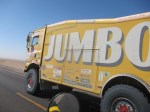
Our run up to Arequipa took us along the main Route5 which was shared in a couple of long sections by the Dakar racers and support crews. On these sections they are definitely not racing; in fact they get big penalties for breaking the speed limits. Which means that we less law abiding folk can pass them and take a closer look.

Jan 11th – Robby Gordon having a bad day

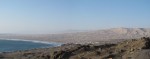
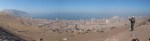
One more day in the Atacama Desert as we left Iquique for Arica. The road from Iquique (pronounced ee-kwee-kay) clims dramatically up the dunes and cliffs to deliver a fantastic view of the city the ocean. This photo was taken from what looked like the city dump on the hill overlooking the town.

The rally is really taking its toll on the vehicles and the riders and the drivers. Most of the race and support vehicles came over on one chartered ship from France so, if you want to get them home, you have to get them back to Lima for the same charter out of South America. Many of the support trucks are now towing broken down or crashed or wrecked or broken equipment – the toll on people and machines is extreme.

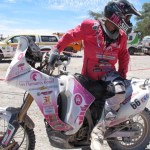
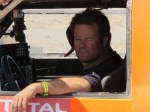
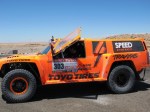
One other unhappy camper is Robby Gordon, the flashy, ex-Nascar, self-promoting Hummer driver and US favourite for the race. He is driving a 1000 hp Hummer but is still behind the two leading MInis. Today his woes increased when he was disqualified for some illegality in his car. He was allowed to keep going while an appeal was heard and I ended up following him for miles on the liaison up to Arica after the stage. When he pulled over to get a breath of air, I managed to stop and get a couple of pictures. 

Jan 10th – One less rider

Today was a ride from Antofagasta to Iquique but, sadly, Gale was unable to continue with us after a tumble in the desert the day before that banged up her shoulder and ankle. We were very sorry to leave her behind.

We are still in the Atacama Desert and, although we rode along the Pacific coast, the world is totally arid. There are not even any insects; after days of hard riding, there is not a single bug splat on my helmet. The scenery is hard to describe and impossible to photograph.

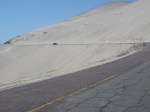
Our destination was Iquique where the rally special stage ended with a plunge down some of the highest cliffs in the world. The bikes, cars, and trucks all plunge about 1800 feet from the top of the dune; straight down, full throttle. In the picture, you can see a tiny white spec of a car with a plume of dust right in the middle of the frame. This was the Mini of the French driver Stephane Peterhansel who is currently leading the rally.

Jan 8th – Not sure how to describe a desert

We left Copiapo and headed up the Pacific coast for a while before cutting inland through the middle of the Atacama Desert as far as Antofagasta.

This is the driest place on earth. We drove past hills and mountains and valleys and plains just like driving through eastern Oregon; but here there is nothing alive anywhere. No trees, grass, cactus, bushes – nothing but sand and rocks. It just doesn’t rain here – not even during Wimbledon – never. It’s something to do with the coastal currents from the Arctic being too cold to evaporate and create rain clouds. From the Andes to the Pacific Ocean from Copiapo for 1000 km to the north – nothing.

Uninhabitable, inhospitable, sterile, brutal.

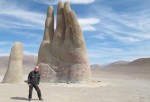
Stopped to watch the rally coming though in the middle of a huge 400km stage and ended up at the Hand in the Desert.

The group above (L-R) – Jim Hyde, Michael Ruppert, Wim DeBruyn, Charlie Walton, Gale Browning.

I remember Doug Printz telling me that there’s always one asshole in any group and, if you haven’t figured out who it is, then it’s probably you. That’s the conclusion I am coming to.

en.wikipedia.org/wiki/Atacama_Desert