Copiapo Mining Disaster – Los Treinta Y Tres.

We are staying in Copiapo which is the nearest town to the Chilean mining accident and the rescue of 33 miners; known locally as simple Los Treinta y Tres. So a quick look at Wikipedia produced the Lat/Long coordinates of the site and the GPS then took us out to the mine – the San Jose Copper and Gold mine.

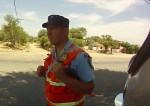
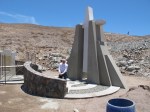
If this was anywhere else in the world, there would be an interpretive centre, a gift shop, and buses of tourists. Here there was an old watchman, nothing to mark the site, and a half-finished memorial. Apparently the actual rescue capsule is in front of the Parliament building in Santiago and nobody can agree where to put the backup capsule or how to memorialise the rescue.

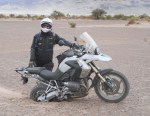
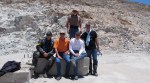
The actual hole is capped (don’t want anyone falling back in there) but we at least managed to sit and get a photo at the site.

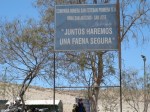
The sign that is left by the entrance says “Juntos haremos una faena segura” which means (I think) “Together we will make a safe workplace”. Well they DID get the miners out even if it did take 68 days. Luckily the guys weren’t mining in China.

Mining Accident – http://en.wikipedia.org/wiki/2010_Copiap%C3%B3_mining_accident

How to cross the Andes in style. Or at least in a cloud.

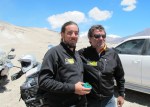
Meet Nacho and Dario our two Argentinian fixers. They are driving a support truck for our little group and have made all sorts of problems disappear. Nacho talked the Dakar authorities in Argentina to pre-clearing us through Argentina and Chile immigration, convinced the cops in Fiambala that we were “part of the rally” so could join the convoy over the Andes when the road was otherwise closed, produced fuel in the middle of nowhere, greased palms at official “checkpoints”, found accommodation ahead of time in villages that had no hotels, and has generally kept us fed and watered (even more important at altitude)

In this photo Nacho, is holding a fine package of fresh coca leaves which we all chewed from one side of the mountains to the other. The locals have been doing this for centuries to offset the effects of altitude sickness and so did we, officer. The taste is no worse than putting a herbal teabag in your mouth and the effect was as advertised – a fine day of riding was had by all. The disgusting photo is of my wad as I got rid of it as we dropped down into more breathable air. This stuff should be standard issue for every ski trip.

Jan 6th – Over the Andes by road.

From Fiambala in Argentina to Copiapo in Chile should have been a 500km ride with about half on unmade roads. But the day before we left there had been a huge storm; Fiambala normally gets 10cm of rain a year and this time it got 10cm in one day. As a result we added a 140km detour, all on dirt roads because our planned route in Chile was totally washed out and everyone had to move in a convoy on a new, hastily assembled, route.

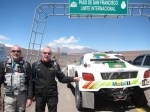
We left at dawn and climbed up to 16,000 feet to cross the Paso de San Francisco into Chile. The road to this point had been very well maintained tarmac but, as you can see in the photo of the summit, the tarmac ended at the border. Riding along with all the other vehicles overtaking and ploughing up dust, was interesting when there was then no visibility.

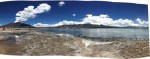
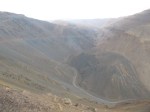
The drive is spectacular to say the least; climbing through the dramatic rock formations, across a plateau at around 11,000 feet with views of mountaintops all around and wild Vicuna moving through, into Chile then the challenge of wide but unpredictable dirt roads, the Green Lagoon where we stopped for lunch along with a bike competitor who grabbed a nap and told us he hadn’t slept for 29 hours, down amazing swithbacks that dropped a couple of thousand feet in a very short distance. Every turn was breathtaking.

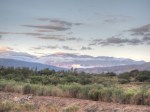
We then arrived at Copiapo, late and bedraggled, after crossing the southernmost end of the Atacama Desert; a place where it has not rained in recorded history. We rode about 150km in this area and there is no life to be seen; no grass, lichen, cactus, tress, not a living thing. Well I didn’t look for bacteria.

Jan 5th – If you dress the part, you get the part.

Today was our first real day following the Dakar caravan as they moved from the overnight camp (they call it the “Bivouac” in Dakar-speak) to the next stop and the actual timed race for the day (the “Stage”). They call this part on the road the “Liaison”. So that’s all the Dakar vocabulary you need. On this route we are constantly being overtaken by race bikes, cars, trucks, and the whole entourage of support trucks for the teams, food, TV, tyres, and every other imaginable purpose.

It also becomes clear that the local townsfolk think that any big bike covered in sand and ridden by a stranger in fancy gear is part of the race. So everywhere we went there were whole families out on the street to cheer us on. Like a redneck 4th of July, there were houses with all their furniture on the street with the family, grannie, and the kids on the sofa hollering and waving flags.

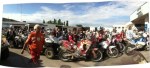
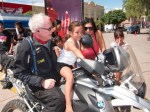
Half way to Fiambala we came to the only gas station on the road and there were the entire field of bikes queuing quietly to fill up before their special stage. When we completed our own fuel stop in Tinogasta, we had our own moment of fame. A few of us parked on the town square and I was mobbed by kids and families wanting to have their photo taken with one of the Dakar riders. I was dressed right, had a bike they’d never seen, and was just sitting there, and I was soon putting the local kids on the bike and being grabbed by everyone; two kids even asked me to autograph their arms because they didn’t have any paper.

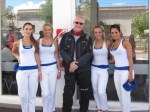
The YPF girls at the gas station were professionals, needless to say. Please note that you can see both my hands in this photo; you cannot see the lady chaperone who accompanied them as I suppose that the guys they normally meet are not as chivalrous as the average Engligh rider.

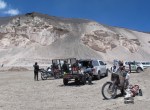
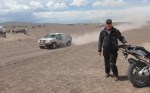
At Fiambala, we took off to the end of the stage and rode a little further up the trail to get closer to the action. Just like any rally, there are complicated security and safety arrangements at the checkpoint, but they cannot put a fence around hundreds of miles of desert and gets crazy out there. People get very close to the stage as you can see.

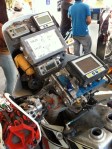
I also had my first, of many I am sure, reminders that you start off really slowly on a heavy GS bike on sand. When I had succeeded in digging myself down the axle with no hope of success, I looked to my so-called friends for help and all I saw was six camera lenses.
Bailing Wire and Garden Hose

Today was not meant to be a tough day; just a blast across the desert to
intercept the Dakar competitors. But it did not turn out that way.

First, my bike ran out of gas within about two hours of leaving in the
Argentine back country. The gauge said full but the tank said empty and the
tank was right. Note to self, never trust those gauges. That was a first.

Then Wim decided it would be possible to tow me closer to civilization and
hooked up a couple of loops of bailing wire that he had “borrowed” from a
local unattended farm building. We eventually went about 15 km this way and
found our support folks. Dario “borrowed” a chunk of garden hose to syphon
gas from another bike and we were off again. Except I owe Dario a couple of
cases of beer for the amount of gas he swallowed. Lots of creativity from
everyone.

A few miles further we were pulled over at one of dozens of police
“control” points and had a zero communication episode with the officer. My
feeble Spanish does not have the vocabulary for “I pulled you over because
you overtook someone on a double yellow line (I didn’t actually) which is a
serious offense but my colleague and I would be happy to overlook the
infraction in exchange for a small contribution to the Provincial Police
Widows and Orphans Fund”. Shortly thereafter our Argentine fixers, Dario
and Nacho, showed up and common sense prevailed but not before 20 pesos
changed hands; for administration costs. He was also told that the funny
camera on my helmet had recorded the conversation, which was true.

And this was all before lunch.

The rest of the day was an ugly, 110 degree, blast to Chilecito. We are now
all camped out in a private home because there are no hotels here at all.
Tomorrow off with the Dakar competitors to Fiambala and thence to Chile
over the Paseo de San Francisco at 5000 meters altitude.

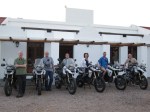
This is the last day we will be rested and clean for a while. Our bikes arrived and, after a little bit of messing around to install personal paraphernalia like GPS and bags and cameras, we are ready for the off tomorrow. We have been based at El Estancia del Pilar that is mainly used for hunting and fishing expeditions. On the western side of the Pampas, about 600 Km north west of Buenos Aires and within sight of the Andes, the guest book talks about the exploits of the dove hunters, one of whom was delighted to report that his son had shot one thousand doves IN ONE DAY. What? Why? I can imagine that doves are really a pest in this largely agricultural area but a thousand? Truly the unspeakable in pursuit of the uneatable. So tomorrow off to Chilecito and the Andes.

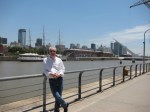
On the way to Cordoba, Argentina to meet my Dakar Rally gang, I had the chance for a quick tour of Buenos Aires. No sleep on the ten hour flight from Houston but who cares.

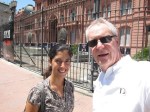
With my arranged guide, Agustina, we managed to see La Boca an old barrio that is now touristified and serves as the centre for tango and homage to Diego Maradona who grew up there and played at the football ground in Caminito.

Then the antique shops in San Telmo and lunch in Puerto Madero. The a walk around the Plaza de Mayo and the Presidential Palace where apparently the Falklands War is still being fought by former soldiers who proclaim that “The Malvinas are, and forever will be Argentinian” Tell that to Margaret Thatcher and see what she says.

Then the cemetery at La Recoleta for Evita’s tomb – you know you’ve found it when you find the crowd. Very hard to find as she is listed under her maiden name.

Finally managed to sample Dolce de Leches at Freddo.

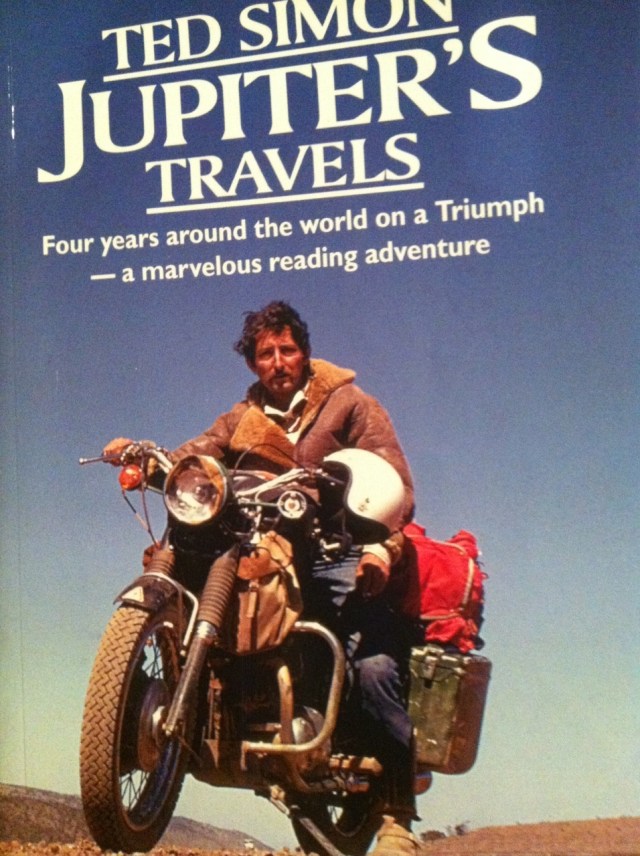
I just finished reading Jupiter’s Travels by Ted Simon.

This is the story of his 1970s four year trip around the world on a Triumph Tiger; one of the first times anyone had done this and his trip was certainly the catalyst for many others including Long Way Round. No, I am not contemplating doing the same trip but his insights and observations are fascinating.

“I am learning, as I make my way through my first continent, that it is remarkably easy to do things, and much more frightening to contemplate them”.

“In Colombia it was the custom to do murder and violence. Yet I found the Colombians at least as hospitable, honorable, and humane as the the Argentines, whose custom is merely to cheat. Arabs have the custom of showing their emotions and hiding their women. Australians show their women and hide their emotions. In Sudan it is customary to be honest. In Thailand dishonesty is virtually a custom, but so is giving gifts to strangers.”

I was also struck by how the world has changed since he made this first journey. The places that were then dangerous military dictatorships (Brazil, Chile, Peru) and now booming democracies, but many places he passed with no regard but for the poor state of the roads are now highly dangerous and dysfunctional states (Pakistan, Afghanistan) Who is to say that these places could not turnaround like South America.

I had the pleasure of meeting Ted Simon at an off-road event this year and chatted with him about his later trip when he repeated the same journey at the age of 70.

Never say never.