English Corner – That’s All of Australia

A ride around Victoria is visually like a ride around England but without the ugly parts.

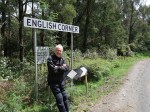
Everywhere resembles somewhere and everything is named for somewhere in the old country. We have visited Sale, Quorn, Stratford, Richmond, Anglesea, Torquay, Peterborough (more than one), Kingston … the list goes on.

Some of these places really do look like their namesakes; riding to Macclesfield through the Adelaide Hills you could imagine a drive across the Peak District into Cheshire with grazing sheep, sparse trees, and a few rocky windswept outcroppings. You have to ignore the odd kangaroo for this illusion to work of course.

Mansfield was actually named for Mansfield, Nottinghamshire but bears no resemblance to the one I know. The one here is in the foothills of the Victorian Alps, was founded on gold discoveries, and is now the gateway to the ski resort at Mount Buller. Like almost every town we have discovered in Australia it’s fresh, clean, friendly, and energetic – not so the other one.
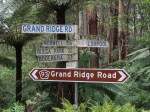
Grand Ridge Ride

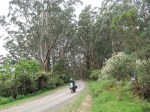
The Grand Ridge Road (when Australians say “road” it does sound like “ride”) is 132km of motorcycle delight that runs along the ridge of the Strzelecki Ranges with occasional glimpses of the Bass Strait between here and Tasmania. This is the most southerly point in our little adventure.

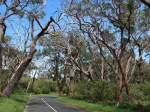
The route is a logging road between stands of pine and massive old eucalyptus. Plantation and rain forest interspersed. A spectacular ride apart from the constant threat of logging trucks whose drivers do not seem to care if they hit anything.

This was our last real backroad dirt section on this trip – from here we are winding down and winding back to Melbourne.

Ghosts of Fires Past

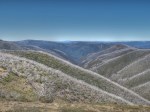
Riding on the Great Alpine Road in Victoria’s High Country is an eerily beautiful experience. Leaving Bright and heading south over Mount Hotham, you climb to around 6,000 feet very quickly and pass through clearly distinct layers from grassy valleys with grazing cattle to steeply wooded hills to an alpine tortured landscape – and ski lifts. Along the way the Snow Gum trees (Eucalyptus pauciflora) change from massive tall specimens to stunted bushes that are twisted and gnarled as they struggle to survive the loads of ice and snow that covers them in winter. Hard to imagine these are the same tree they look so different.

One thing they have in common …  how they burn.

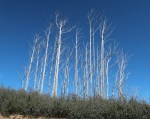
This area has had severe bush fires in 2003, 2006 and 2013 that consumed the leaves and boiled the sap out of the thin barked tree leaving millions and millions of grey, bleached skeletons as far as the eye can see. Strangely beautiful.

The battle here, as in other parts of the world, rages between forest experts and farmers. The cattle were removed from these forests years ago to prevent damage to trails and water courses but the cattlemen claim that their animals can help trample and eat the fuel load in the forest. 

image

Don’t be THAT guy,

Don’t be the guy that leaves the wireless remote key to his BMW on the back of the bike instead of in his pocket, The guy who then rides off so the key falls off in the street. The guy that luckily made it back to the bike rental place before the bike became immobilized forever because the key fob is a couple of miles away being crushed by traffic on one of Melbourne’s busiest roads.

Don’t be THAT guy. That guy is me.

That’s why I am riding a cherry red V-Strom POS (Piece of Suzuki) instead of the black BMW R1200GS on which I started this adventure.

I am actually thrilled that this happened just when we were back in Melbourne doing some repairs. If I had pulled this stunt in Broken Hill, that would have been the end of the trip. As it was, Trevor at Ride Australia Motorbike Rentals, took off on his own bike to try and find the key and then managed to find me another bike for the rest of the trip. This guy is a miracle worker.

I, on the other hand, am a complete idiot.

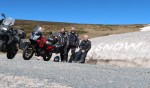
As we made our way south today from Bright to Orbost, we met a swarm of riders heading north after the MotoGP at Phillip Island. When I parked with these guys, NONE of them talked to the V-Strom rider. Not even the Kawasaki Ninja guys.

As Ned Kelly said “Ah Well. It’s Come to This. Such is Life”.

Ned Kelly – Such Is Life.

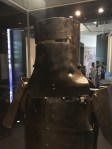
Ned Kelly is Australia’s only folk hero. Was he a rebel fighting for those downtrodden by the earlier squatters or simply a thief and murderer with a good marketing plan? Well he could have been both and he is certainly remembered for his last stand in 1880 at which he and his gang came out fighting dressed in homemade armour from head to toe. The gang all died, Kelly was injured and captured, and sentenced, and hung in Melbourne Gaol. 

His last words were “Ah well. It’s come to this. Such is life”. He was 25.

These final events took place in Glenrowan, Victoria where we rode today through the beautiful King Valley countryside from Mansfield. We enjoyed a view of the events at Ned Kelly’s Last Stand, a museum show of complete over-the-top animatronic mayhem built by Bob Hempel in 1980 and developed and improved every year since.

I can see why the whole shebang gets mixed reviews but I loved it for the unapologetic, over enthusiastic kitsch.

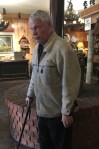
We also had the unabashed delight of meeting and chatting to Bob before and after the show. He is now in his 80s and still lives with his grandson in rooms mixed with the Ned Kelly show. He is clearly still completely engaged in his creation even after 40 years and he is a natural storyteller. He had a big dream and he still pursues it probably without a care for what people think. He told us about his grandson “making the whole show better because he understands all that computer stuff” and regaled us with the tale of the visit by George Lucas who, I can totally believe, loved the show.

Corny but sincere and totally committed to Ned Kelly’s defense.

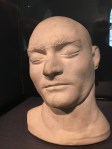
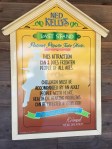
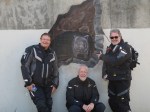
Photos – Post execution death mask taken from Kelly and the original armour – both almost hidden in the State Library of Victoria I visited a few weeks ago. Bob Hempel the creator of Ned Kelly’s Last Stand. Warning to customers and an example of the dioramas within. Me and Ned shooting it out with the police.

The Great Ocean Koala

Today we tackled the Great Ocean Road from Port Campbell to Geelong – 200 Km of spectacularness and fun on two wheels. We also threw in a dirt road loop up through the Otway National Park to Gellibrand – extra credit and extra fun through unlogged temperate rain forest. Hard to photograph the road and you don’t want to see the grins.

Three things stand out.

First the road itself is a pure delight. We hit some roadworks and a couple of slow vehicles but basically we had the road to ourselves for hundreds of curves of sheer grin-inducingness between the neat, charming, friendly seaside towns along the way.

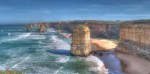
Second, the cliff formations on the west end of the route are truly stunning. Here is an image of the 12 Apostles.

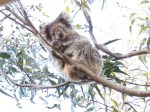
Finally, this is one of the places that you can predictably see koalas in the wild. They sleep 18 hours a day and this guy was in a post eucalyptus eating haze up a gum tree (literally) near Kennet River. Fun facts – koalas are not bears but marsupials (babies in pouches) – “koala” is from an aboriginal term for “no drink” because they, well, don’t drink – 80% of koala habitat has been lost and the rest is under threat. We saw a number of koalas on the road to Otway Lighthouse but 400 of them had been relocated to Kennet River because they had eaten themselves out of their preferred leaves, killing the tress in the process.

The Wombat of Warrnambool

Backstory if you haven’t seen the delightful video. Artist decides to draw a wombat in pastel on the railway bridge by his house. Local graffiti removal guy thought it was so lovely that he sprayed it with a few coats of clearcoat to preserve it forever. Artist returns to clean off his chalk. A friendship is born with the (now) graffiti preservation officer.

Watch the video here …  https://www.youtube.com/watch?v=jmccJgw66vA

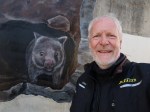
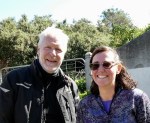
Anyway – we were going past here anyway so I tracked down the art and here we are. The photo was taken by the artist’s next door neighbor, Claire, who came out to chat and we met a couple walking their dog who were also delighted with the attention. Everyone’s a winner.

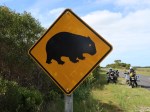
We, alas, did not see the artist or his new buddy – nor did we spot a wombat on the road. We are still looking.  

Roadside Kitsch – Finally

We have now ridden over 3000 miles in three states in Australia and never once seen a stupid corny “roadside attraction” … until today.

If we had driven 3000 miles around America, I can guarantee we would have seen a statue of Paul Bunyan with an axe, or a man made of mufflers, or a huge exterminator guy with a top hat and a hammer, or the world’s largest ketchup bottle, or a motel made of wigwams, or foamhenge (yes this exists) … well you get my point. There are hundreds of kitsch attractions that try to get you to pull over and buy something – and maybe try to prove that bad taste can be high art.

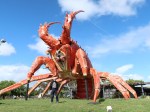
No so in Australia until we got to Kingston on the South Australia coast where there is a 50 foot lobster and “convention centre” … which is currently for sale to some enterprising new business owner.

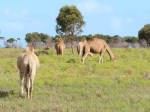
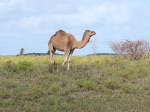
The day was made even more bizarre by the discovery of a herd of grazing camels on the way tp Robe which is a delightful little sailing port with the bluest water I have ever seen.

Let’s call this day a strange version of “surf and turf”.

Rocket Men in Woomera

Woomera is the location of the Royal Australian Air Force (RAAF) base that supervises the missile test range that was setup jointly with the RAF after the Second World War. Initially it was over 100,000 square miles – the area of New Zealand or Colorado – but now it’s half that and still the biggest in the world.

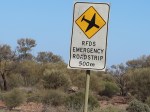
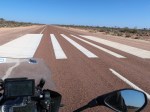
The ride on the Stuart Highway to get here from Coober Pedy and onwards to Port Augusta is mind numbingly boring – 650Km of nothing at all except the odd errant emu to keep you awake.  A chunk of the highway is also marked as a landing strip for the Royal Flying Doctor Service.

If you wanted to put a missile testing facility in a place where nothing could get damaged, then here it is in the sterile centre of Australia. Indigenous Australians would and did take issue with this assumption but their voices were not heard in the 1940s.

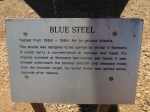
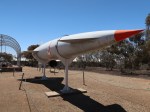
In the town that is now publicly accessible there are two blocks of old missiles on stands with very rudimentary little plaques. All rusting, peeling, and fading in the fierce sun – signs of a more glorious past for the aerospace industries of two countries now both eclipsed by larger military industrial complexes. Weapons like Blue Steel that was a precursor to cruise missiles and the incomprehensibly named Sea Slug.

Not shown in the local displays is the fact that Woomera was also the site of an immigration processing centre built in 1999. A sign of a different political development and a desire to keep refugees along way from public view. It didn’t work. The centre had capacity for 400 people but grew to 1500 and led to riots inside the camp and massive protests outside. It was closed in 2003 and most of the people there given temporary status whilst their asylum claims were being processed. It was actually run by a US private prison company showing the reach of this particular pernicious recent development.

From Quorn to Adelaide – A Ride Through Science and Time

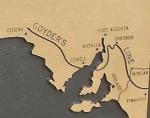
In 1865, George Goyder the Surveyor-General of South Australia rode over 3000 Km to develop a map that would help farmers decide where they could plant crops. He drew a line across the colony that roughly corresponded to 10 inches of rain per year and declared land to the north “liable to drought” and to the south safe for arable farms. Some farmers ignored his map and planted to the north as they believed in the popular doctrine from the US West that “rain follows the plough” but this fallacy led to them abandoning their farms

Today, a century and a half later, this delineation is still very much obvious and a testament to a wonderful piece of science given the resources at the time.

We left Quorn and rode through dry, lifeless scrub with no grass and very little other vegetation but within 30 Km we started to see gum trees with their mangled and gnarled trunks in the creek beds where there is occasional water. By the time we had gone 50 Km, we were in rolling grass and farmland and after that perfectly curated wine country. 

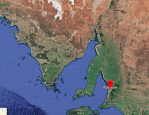
There is a small marker to honour Goyder near Mount Remarkable in Melrose and, looking at the latest Google Maps satellite picture, it is clear that the line has moved south as the climate has warmed and dried. Something Goyder could not have foreseen.

This route is such a pleasant jaunt. It takes you through an Australian time warp – like someone set the dial back to 1965. The townships were all perfectly preserved from another epoch and we did not see a single “big box” store in any of the towns. The general store in Georgetown was not a museum piece; just still the hub of the town with everything that anybody needs that nobody has updated for decades. I asked the shopkeeper serving Bill about business and he said “Well I can still eat”. 

We didn’t let Michael into the Wilmington Toy Store as he was salivating.