From Greece to Coober Pedy

Coober Pedy is the largest opal mining area in the world and provides most of the world’s gem quality opals. The town is clearly past its peak, however, and most of the town’s businesses seem to cater to tourists looking for boomerangs and didgeridoos rather than opals.

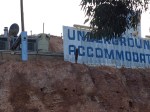
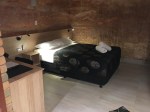
Most of the residents live underground in houses that have been made from old mine shafts and many of the hotels are made this way too including the Lookout Cave where we stayed.  An underground hotel with a sunset view over the town – an amazing combination.

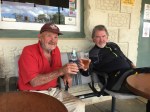
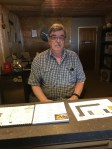
The hotel is owned by a Greek family and I chatted to the patriarch, Nick. His father moved here in 1959 and Nick followed the year after at age 16 with the rest of his family. He remembers when they came it cost them 250 Pounds but those coming from Britain could get a ticket for 10 Pounds – these migrants are still called the “Ten Pound Poms”.

He worked with two brothers who were pushing a mine into the side of the hill “with axes and dynamite” and who were living in the mined dugouts until the late 1980s. When the mine didn’t work out, they rented the first two dugouts and kept digging more. Later Nick encouraged his daughters to buy the property and they opened the hotel in 1993.

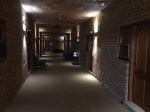
On the hilltop above a very unremarkable frontage, you can see the vents to all the rooms and the original oil drums that lined the first vent to the mine. But when you step into the hallway and rooms, you get a real shock as you enter an entirely different world. Outside is dust and heat and dry wind but inside is a superbly appointed and perfectly laid out luxury hotel. 

The interior is always 22-25 degC year round – whether it’s 50 degC or 5 degC outside. A gem in a hillside where no gems were found.
How Do You Define the Outback?

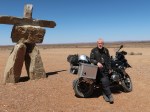
We have asked people along the way how we’ll know we are in the “outback” and nobody has provided us with anything like a clear definition. The other day one chap said “Well, it’s not an exact science is it mate? It’s where the bitumen ends and nobody lives unless that have to”. The last part of the answer clearly had a racist overtone; only indigenous aboriginal people (blackfellas) “have to” live there. But the young lady running the William Creek Hotel also said it was for people “who couldn’t function in cities”; misfits who find their way here like her, “home is my car really, and I’ll move on when it gets too hot”. That day is approaching fast.

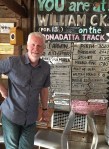
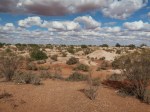
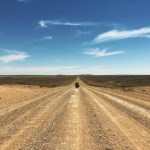
One thing is certain, if the outback is a physical definition, we are clearly in it now. We left the beauty of the hills and creeks and gum trees in the Flinders Ranges and headed north to Marree and along the Oodnadatta Track to William Creek, along the southern edge of Lake Eyre; the lowest point in Australia where the rains from Queensland come a thousand miles to evaporate and die.

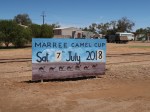
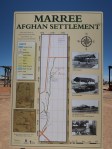
Marree is the turn off to the Birdsville Track and was once a settlement for Afghans who came to run the camel trains. We met a few locals at lunch and one claimed he had Afghan blood. There are the remains of an old mosque and there is a camel festival and race every year.

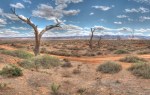
The Oodnadatta Track is more or less the route of the old railway line and the Overland Telegraph Line to Darwin that was surveyed by the explorer John McDouall Stuart in 1861, and has been a major aboriginal trade and dreaming route for millennia. Coming north to Marree out of the Flinders the vegetation disappears and, leaving Marree, you step into a whole nother world of emptiness; occasional glimpses of Lake Eyre which was wet for a couple of months this year but is now a glimmering white sheet of salt. In 1964 Malcolm Campbell came here to Madigan Gulf and ran Bluebird across the salt at 403 mph for a new land speed record. These efforts are now on more accessible lake beds. From here it is nothing followed by nothing by nothing for 200km to William Creek.

William Creek is in the middle of the Anna Creek Station, the world’s largest working cattle station. This station is over 9,000 square miles (7 million acres) with around 18,000 cattle in a good year but in drought conditions we have not seen a single creature but flocks of parakeets.

We feel like we have arrived in the middle of the country but we are not even close – it is still another 1,000 Km to Uluru (Ayer’s Rock) and we are not going that far.

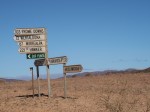
You Know You are in the Middle of Nowhere … 

… when You are 267 Kilometers to Nowhere.

Reginald Sprigg was an Australian geologist who made two huge impacts in his life.

First he discovered fossils in 1946 that established proof of the first animals that helped date and explain the Cambrian Explosion – the amazing proliferation of ever more complex creatures after billions of years of almost no change in the Earth’s evolved organisms. Spoiler alert – we all come from jellyfish – sorry to break it to you. He was out surveying old mines for potential new uses and, reportedly, came across these fossils whilst having lunch. You stub your toe in the vastness of the Australian outback and, change science forever. You have to know what you are looking for I suppose.

This was in the Ediacara Hills – seen in this photo taken in the Flinders Ranges near Parachilna in South Australia. They even added the Edicaran Period in the geological table to recognize this change in the way we have to think about evolution.

Then in 1968 he bought a few hundred acres in the Northern Flinders that was once a uranium exploration site that he had extensively surveyed (yes there is uranium under here) and turned it into the Arkaroola Wilderness Sanctuary. You know this is in the middle of nowhere when it’s hundreds of kilometers to nowhere.

Tomorrow, sadly, we are leaving Arkaroola after a stay they was extended to fix my second serious puncture. The area is spectacular, the hotel and food are perfect, and the people here are a delight.

Within an hour of getting back from a day ride with a serious tyre problem, the staff had figured out someone was coming up from Port Augusta (350 Km away) and could bring a tyre that someone else could collect from Copley (150 Km away) and get here by the afternoon. No fuss and a literal and figurative bush telegraph was setup to get us out of a bind.

“No worries mate. Too easy” as they say in Australia.

Warn Them or Film Them?

A question for my adventure bike riding friends. If you come to a very difficult section of track well ahead of your riding buddies, do you a) warn them or b) film them? You know, just in case.

Well Bill Whitacre chose option b). Thanks Bill.

This is part of a trail near Arkaroola in the Flinders Ranges in South Australia. The drop off is a lot worse than it seems on this video and there is no indication until you fly over the crest. Actually, being warned would not have made this easier. Just relax and stay off the brakes. A hundred yards further on I hit a hole hard enough to knock my feet off the pegs and rip a hole in another tyre.

Here they call that grey stuff “bulldust”. No idea why.

What Wine Goes With Emu?

We continue to meet the nicest people everywhere we go in Australia. We are rapidly coming to the conclusion that ALL Aussies are nice.

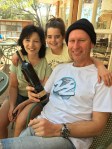
Stopping for breakfast in Wilpena Pound – a beautiful amphitheatre of mountains in the middle of the Flinders Ranges where we had camped the night before – we met Matthew and Kim and their kids. Like almost every Aussie we’ve met, they had both traveled the world and they swapped tales of long drives across the American west or visiting Hungary and paying the way working in wineries.

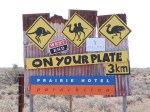
As we were all getting ready to leave, they asked what kind of wine I liked. I joked that we needed something that would go with emu as we were staying that night at the Prairie Hotel in Parachilna whose speciality was ‘Feral Mixed Grill”. Matthew and Kim pulled from their stash a bottle of Barossa Valley cabernet sauvignon from Black Wattle winery and hoped we’d enjoy their country.

The wine went superbly with my chargrilled kangaroo fillet with sweet potato puree, saltbush gnocchi, warrigal greens and red wine chilli quandong jus.

The Australian welcome never stops.

Camels For Export

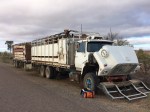
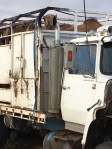
This morning chatting to a bloke at the petrol station, I asked him what he was doing in Copley. He told me he was driving a load of camels to the abattoir in Peterborough, South Australia but he’d broken down.

Not an answer I was expecting.

Camels and their Afghan handlers were first brought successfully into Australia from 1860 as the perfect solution for exploring the outback and the Burke and Wills expedition was the first that used them. The Muslim cameleers soon began running their own camel trains and, by 1890, dominated this business. They encountered a lot of aboriginal groups and a sort of mutual trade arrangement was setup – Afghans taking goods along traditional aboriginal trade routes like the Birdsville Track and bringing in new goods such as sugar, tea, and tobacco.

When motorized transport arrived the cameleers were displaced and the camels were simply abandoned into a world well suited to them. By 2008 it was estimated that there were a million camels in Australia – the largest feral camel population in the world – doing enormous damage to the environment and infrastructure.

The numbers are now closer to 300,00 after culling and other controls. One of these controls is to sell the camels as food to those countries that appreciate them and the Middle East countries love the fact that the animals are free from disease and free from the political issues in North Africa.

Hence the broken down truck in Copley – on its way to supply the Saudi need for camel meet. Not exactly selling sand to the Arabs – but a close second.

Kangaroo Carnage

After you get over the initial delight in seeing so many kangaroos in the wild, bouncing in the sand and peeking at you over the bushes, you soon begin to realize something is wrong.

New South Wales has been suffering drought conditions for over six months. We have seen Road Train loads of hay being trucked in to help save the cattle and we met a farmer in the back country that told us that their sheep stocks were a third of normal as the rest had been sold rather than have them starve.

None of this works for wildlife. 

Kangaroos are herbivores eating grasses, flowers, ferns and leaves and the countryside in the outback currently has nome of these in any abundance. The recent rains have made some grass grow but a lot of this is where the water runs off the roads.

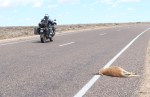
Kangaroos eating closer and closer to roads has predictable consequences. On the 200km stretch from Wilcannia to Broken Hill on the highway, we probably saw at least a thousand dead kangaroos. Hard to say how long each had been there but that’s a staggering number of dead animals.

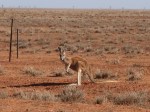
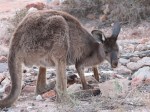
In the other photos, the red kangaroo was just outside White Cliffs but too weak to run away. The grey guy was a few feet from out motel essentially scavenging for scraps.

Heartbreaking.

White Cliffs – Outback and Laid Back

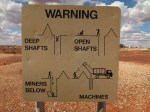
White Cliffs was once an opal mining mecca in the southwest of New South Wales. Today there are a couple of commercial scale operations but most of the mining appears to be in the “Heritage” area where miners have tiny claims and are limited to using “heritage” methods; basically a pickaxe and a wheelbarrow. That whole area is covered with death trap holes surrounded by “mullock”. We were told that most of these plots cost A$87 a year and were worked as a hobby. Not easy to see the fun in this at all.

About 80 percent of the people of White Cliffs live in dug-outs; underground houses made from expanding opal mines or simply augured into the hills to make dwellings that are a respite from the heat. The first solar power plant in Australia was built here because some professor calculated it had the highest solar exposure. Our motel was built this way with caves as rooms about 20 feet underground.

There are about 100 citizens in town and, when we pulled up to the pub for a quick beer, we never left, stayed for dinner, and ended up meeting about half of them. Do you all come to the pub every day? “Oh crikey no mate that’d be silly. Only 5 our of 7 days usually”. It must get lonely in the dug-outs.

Add to that, Central Darling Shire, within which this town lies, is the largest Shire in NSW and yet has the smallest population. It covers an area about the size of the main island of Tasmania and yet has a population of less than 2,000 people. So White Cliffs is a big percentage of the Shire.

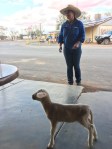
Most at the pub were older folks who had moved here for the “White Cliffs lifestyle”. I asked what that was and one lady told me it meant things get done according to their importance and everyone knew everyone and looked out for each other. Most showed up in a small old ute with a dog in the back. One lady showed up with her two kids and a rescued lamb being bottle fed and cavorting with the dogs. They all had stories to tell and plenty of time to tell them.

We met Ken Davis who pulled out his driving license for me to prove he was actually 80. There was absolutely no need to do that; Ken looked like he had lived every bit of every one of those years. He’d been a sheep shearer for 20 years and worked as a mechanic in various mines the rest of his working life. He’d been to America and enjoyed it but couldn’t “understand why your bloody revolving doors go the wrong way round” and then said “And what’s with all that tipping everyone? Why can’t you just pay everyone a living bloody wage and not make them beg for tips all the time?”

No argument from me Ken.

Burke and Wills – The Disastrous Expedition that People Still Talk About.

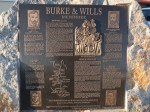
In1860 the leaders in Melbourne mounted an expedition to explore a route across Australia to connect the city to trade routes to Asia and, equally importantly, the new telegraph network to London. Four of the party did actually make it 2,000 miles to the Gulf of Carpenteria but the Maidens Hotel in Menindee is the last place the leaders of the expedition were seen alive.

Melbourne was in the middle of a gold boom and called itself the biggest city in the British Empire (not sure any of them had been to Calcutta, but I digress). But Melbourne is still a LONG way from Great Britain. The need for connection was urgent so they mounted an expedition and thousands came out to see 19 men take off with horses, camels, and two years of food. To lead the  expedition the city chose Robert Burke, and Irish police officer with no experience of the Australian bush. A choice that doomed the effort from the start.

They took two months to get to Menindee (normally a one week trip for the mail coach), the team fell out and Burke decided to take Wills and two others to go it alone – fast and light – and told the others to wait for them at Cooper Creek. The small party made it back to the agreed rendezvous after three months but one day after the crew gave up on them and left them to their fate.

Over beers at dinner at he Maidens Hotel, the locals here in Menindee but also plenty of other places we stopped still describe what went wrong and discuss new books and new findings about the expedition. This is still an Australian obsession.

Photos: The Maidens Hotel was built in 1842 and is still largely how Burke and Wills would remember it apart from the really cold beer – plaque to remember the disaster.

The Home of the Catalina – Lake Boga, Victoria

Riding through the Murray-Darling Valley area that straddles Victoria and New South Wales is a glimpse into the immensity of Australian agriculture – horizon to horizon vineyards and olives and oranges and almonds and, strangely, carrots.

But totally hidden from view with only one small sign off the Murray Valley Highway, is a museum on Lake Boga that celebrates the Catalina. As the Japanese expanded their aggression in World War II and destroyed a lot of Royal Australian Air Force assets, it was decided to move the squadrons of Catalina flying boats to a new “secret” base on Lake Boga – a few hundred kilometers from Melbourne and several thousand kilometers further away from the Japanese.

In 1985, the Lions Club came across a Catalina that was still intact. It was bought for 50 quid after the war by a local farmer and flown to a lake near his farm where he moored it in the shade and stripped the plane for its wiring and generator that he used to power and light his barn. Other people did the same thing and then melted the metal for scrap but, apparently and luckily, this chap lost interest and the plane sat on his pond for 40 years until the Lions bought it an built a museum around it. Today it sits resplendent as a monument to the courage of those that flew this slow and vulnerable beast and to the crews and maintenance personnel who called Lake Boga home until VJ  Day.

There were apparently 8 maintenance engineers for every one women’s air force personnel who were supposed to be separated from their male counterparts in huts that were called “Blossoms of the Dust’ and “Seldom Inn”. There are a lot more stories than are shown at the museum I’m sure. But I digress.

Thanks to Daryl we got a humorous and moving education on this aspect of Australian history and the ordinary people who made an extraordinary difference.

Photos: The Catalinas were typically flown on night operations and painted black and called the Black Cats” – View from the rear and the toilet that vented under the tail – Michael Ruppert and the 14 cylinder Pratt engine – aircrew – Daryl the Lions Club host – view of the stripped Catalina