The Carved Wood

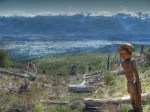
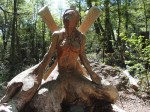
El Bosque Tallado (The Carved Forest) is a collection of 50 works of art carved into lenga trees destroyed by fire high above El Bolsón, Argentina. It was the brainchild of the sculptor, Marcelo Lopez, who wanted to bring attention to his natural surroundings and create an environment for collaboration with other local artists. The works carved into the dead trees where they stand are stunning.

The location is perfect for an adventure bike detour; the 12 Km of steep dirt is a real workout then the you have a REAL workout which is another kilometer walk that goes up a steep scrabble path to a climbers’ refuge with a spectacular view from Cerro Piltriquitrión to the town and the Cordon Nevada across the valley.

A great way to see the country and work off some of the Argentinian barbecue along the way.

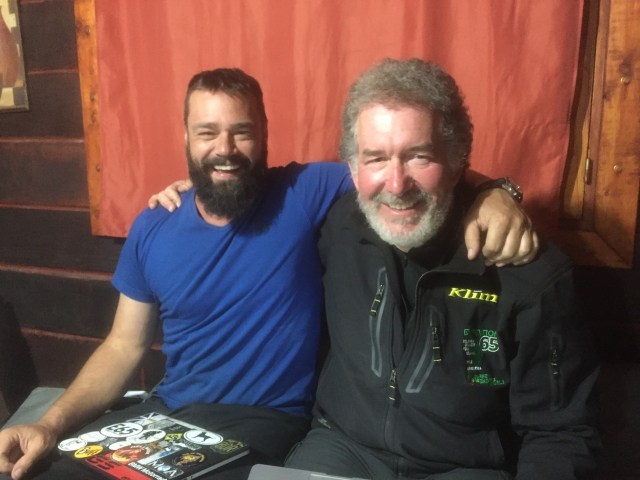
Bill Whitacre and Chris White Have to Leave

These two leave our group today as our accumulated delays mean they have to skidaddle to get home on time.

I will miss both of them.

When you travel with a group of guys for seven weeks you will inevitably reveal something of yourself that is not obvious to everyone else. You cannot hide your demons and you cannot help but show your strengths. We have ridden, eaten, slept, laughed together and experienced highs and lows that would have wrecked a weaker group.

Bill Whitacre is a consummate leader who has always sought to find the common ground whenever we have had disagreements. He has a smile and a dead pan sense of humour that will disarm the most contentious situation and break the ice with any stranger. He has handled all the money and, now he’s gone, we will spend like drunken sailors. Bill professes to be a careful and conservative guy but is ready to do ANYTHING new if it will increase the epic factor on an already epic trip. Bill always thinks these potatoes are “really really good”. Bill is not a good mechanic.

Chris White is the youngest member of this group but has always shown the most mature and interesting ways to think about any new issue or opportunity. He has been ready to help anyone with anything and I am particularly grateful for his time spent riding sweep and helping me get out of a very threatening day in deep sand in Bolivia. He spent almost a week riding on a totally destroyed rear shock with not a single word of complaint. Chris is frank and smart and charming. Chris will make a great father to his soon to be born child.

Safe travels Chris and Bill. See you both again soon.

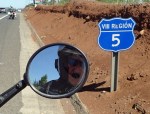
Ruta 5 Chile – Meet I-5 Oregon

When you travel to a new place your mind naturally tries to relate to a familiar experience. This mountain is like the Rockies, this is like riding in Eastern Oregon, oh look, they have McDonalds here too.

But, for the last seven weeks criss-crossing the Andes in six countries, I have never had a Deja Vu moment; the scale, the colours, the smells, the people, the roads, the customs have all been completely disorienting, fascinating, and overwhelming.

Until now. Leaving Santiago, Chile we took the freeway to to get south quickly and cover six degrees of latitude in one day.

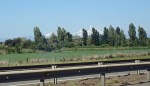
Ruta5 is exactly the same experience as riding I-5 through Oregon. The road leads down through a wide fertile valley with orchards, wineries, and pine forests with the familiar smells of agriculture and logging. We passed 18 wheelers hauling logs and wood chips and signs off to wine tours. The roadside billboards were for fertilizer and farm machinery. The vegetation changed from high desert to corn and grapes and yellow mustard seed and sod farms and evergreens surrounded by yellow Scotch Broom. The valley is edged on the east side by a row of high snow capped volcanoes formed by subduction from the Pacific Plate colliding with South America and on the west side a lower Coast Range to protect the valley from the Pacific.

Welcome home.

One thing that was not the same. Ruta 5 is a toll road that more closely resembles driving along a French Autoroute with regular infuriating toll booths but also an immaculate, well maintained, secure road surface and frequent excellent gas stations that all had great service and food. Interstate-5 would not qualify for any awards for service, surface, or safety. America – learn from Chile.

A Rarity in South America

Santiago, Chile

The usual profile of the cities that we have crossed so far on this trip is of a wealth pyramid. In the centre there is money, history, sanity, and (relative) safety but, as you head outwards, the economic status falls exponentially until the edges are primitive, broken, and desperate; full of struggling people, choking diesels, and burning garbage.

Quito and La Paz follow this model and the worst is Lima, the caporal of Peru, where there is a square mile or two of “normality” surrounded by fifty miles of unplanned development, chaotic transport, and miserable conditions in all directions. These cities have virtually no public transport and appear to have nothing that translates into a building code or city plan.

I assumed this was the model for all of South America until we rolled into Santiago, Chile. But no. This is a beautiful and livable city jammed against a backdrop of the snow covered Andes. We did not ride through a perimeter barrier of slums to get to the city but through well built suburbs with decent shopping on main roads that were pothole free and safe at high speeds. The streets are wide and pleasant and there are dozens of open air cafes with every imaginable healthy food choice.

The city also feels youthful and vibrant. No accident maybe as Santiago’s nickname is Chilecon Valley after a program that has created a Silicon Valley entrepreneurial culture by exploiting America’s main weakness; its awful immigration system. The US turns away new talent and Chile is welcoming them with incentives and investment to try and diversify the economy from just natural resources. The majority of the hundreds of companies that have been nurtured by Start-Up Chile in Santiago have their origins in the US with home grown companies coming in second.

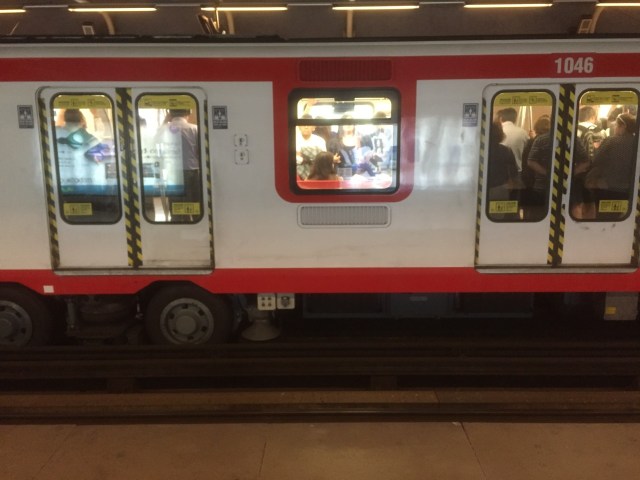
One reason that the city is functional and pleasant is that it has a metro system that handles 2.4 million rides a day. I took a ride and it felt like being in Paris or London and the system recently won the “Best Underground in the Americas”.

The traffic in Santiago at rush hour is horrendous but imagine what the city would look like if another couple of million people were on the streets trying to get to work in cars and buses.

Well I can imagine what it would look like – it’d look like Lima.

Two Missions For The Day

Santiago, Chile – get an oil change and get a haircut.

Check both off the list.

At MotoAventura, Thomas and Mauro did a fantastic job to get an oil change, new tires, oil and air filters all done in an hour. Both are motorbike fanatics – Mauro is from Santiago and showed up on the most immaculate Honda sportbike I’ve seen and Thomas is German who moved here a few years ago with his Chilean wife. In the background is a poster of the Motorex oil we are all using for this trip.

As for the hair, I wandered into a down market shopping centre near our hotel and found Omar in his small salon on the lower level. It turned out that, once we started chatting, one of his clients is the publisher of Off Road and he produced a few issues that he gave me. Omar is from Santiago and has been in that same salon for 34 years; “a lifetime of hair” he said.

Small world.

The First Traffic Ticket.

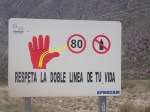
We have now collectively ridden over 100,000 miles on Expedition65 and every one of us has committed every imaginable traffic violation hundreds of times. We have broken speed limits, ridden the wrong way on one-way streets to get through towns, and it is impossible to calculate how many times we have had to overtake on double yellow lines. Bad roads, big hills, slow diesel spewing trucks, erratic buses – you just have to get past them quickly. If we had followed the law, we’d never have been able to cross Colombia.

So it is amazing that to took seven weeks to get a ticket.

Leaving Mendoza to cross the Andes to Santiago, Chile there is a nice highway with great visibility, lots of trucks, and a perfect spot for the local police to park and catch people overtaking on double yellow lines. Sterling and I were at the back of the pack and decided to sweep past a bus and right into the arms of the law.

We tried the “we don’t speak any Spanish” routine (they spoke enough English), we tried the “surely we can pay the the fine here officer” (they were not shaking us down and did not want a bribe), and eventually they took our driving licenses, gave us tickets for offenses described as “Gravisima” (extremely serious), and told us to go to the nearest bank to pay before we’d get our licenses back. That was a 40 Km ride to Uspallata to the bank to pay the $300 fine and ride back to get our documents.

Considering the total cost of fine divided by the total number of offenses since we left, that wasn’t too bad in the great scheme of things.

Darwin Was Here

Traveling today around and across the Andes off the main routes, as we are doing, can be a grueling and dangerous experience. We have ridden dozens of roads that are very high on the internationally recognized “Do NOT Fuck Up Or You Will Die” scale.

Crossing the pre-Cordillera into Mendoza from Uspallata with a view behind us of the high Andes that have to be crossed to get to Chile, you cannot help but get a new appreciation of the tenacity of the earliest travelers in these parts.

One of those was Charles Darwin. In 1831 he embarked on the Beagle as a 22 year-old recent graduate and naturalist for a voyage that was planned for two years but would last five. He paid his own way (with help from his father’s brother-in-law Josiah Wedgewood of fine pottery fame) so that he could maintain control over anything he collected, and he saw his role more as companion to the Captain Robert Fitzroy than having any grand scientific scheme in mind. Both these obviously changed as he learned more about Fitzroy and the natural world he documented.

By 1835, relations between the erratic and difficult FitzRoy and Darwin had reached a low point and they decided they needed some alone time. The Beagle was anchored at Valparaiso and Darwin decided to take a month long trip to Mendoza and back with ten mules, one horse, and two guides. In the previous month he had seen the eruption of Mount Osorno and been on the ground at Valdivia when one of the worst earthquakes hit Chile and leveled the town.

At that time scientists did not see themselves as scientists but as broad thinkers and investigators. Darwin saw that, after the earthquake some mussel beds had risen a couple of feet and he began to agree with Charles Lyell’s theory that the earth was not formed by huge upheavals (vulcanology) but by little changes over a huge length of time.

As Andy Dufresne says in The Shawshank Redemption, “Geology; just pressure and time”.

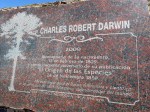
Mendoza now is a delightful place that is the centre of Argentina’s wine industry but Darwin called it “a forlorn and stupid town”. On his journey here he passed the same road we used. Along the way there is an almost invisible memorial to the fact that Darwin discovered fossilized sequoia trees that could not have grown at 9,000 foot elevation but must have been, like the mussels, pushed here by massive forces over an unimaginable period of time.

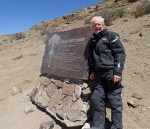
He did not publish any of this until years later but on the bicentennial of his birth (1809) and the 150th anniversary of the publication of The Origen of Species (1859), this plaque was erected at the supposed spot of this discovery.

The original plaque was vandalized by creationists so this is a larger, thicker replacement and it has to be the most remote and unheralded monument I have ever visited; stuck in the middle of 100 Km of dirt road next to a worked out silver mine.

In the 2002 poll commissioned by the BBC for the program 100 Greatest Britons, Charles Darwin was ranked fourth behind Churchill, Brunel, and Lady Di – so maybe the list was a product of the time. He was honored by being put to rest in 1882 in Westminster Cathedral but a memorial in the remoteness of the Argentinian Andes also seems very fitting.

https://en.wikipedia.org/wiki/100_Greatest_Britons

Mountains are big. They don’t fit into a camera.

The highest peak in North America is Denali (Mount McKinley) in Alaska at 6,190 meters (20,310 feet high but there are 46 mountains taller than Denali in the Andes and, as we wind our way south, we have been enjoying a peak fest that will not stop.

In Peru we stayed in Huaraz right under Huascaran (6768 meters), in Ecuador we rode around Chimborazo (6,267 meters) and experienced the climate altering power of these mountains as it is arid and sterile on the downwind side but lush and humid and full of cattle ranches on the other.

In Bolivia the view of La Paz is dominated by Illimani that provides a 6,463 meter backdrop. (Photo above where we had a chance to detour closer to the summit)

Crossing from Chile into Argentina across the high arid Puna de Atacama, we passed Llullaillaco (don’t even try to pronounce this one properly) on whose summit were recently discovered sites where the Incas sacrificed their children to strengthen their community bonds and appease their gods. 

In Barreal, Argentina we stayed in a ranch house on the Rio de los Patos river and the view from the back yard included Aconcagua (the highest peak in the Americas at 6,962 meters) and Mercedario at 6,720 meters.  Not a bad view from the barbecue. (Panorama above) 

The trouble with all this is the impossibility of doing the spectacle justice. As we rode down into Barreal and the peaks come into view as you clear the canyon, the impression is truly breathtaking but disappointing when photographed.

You have to be here.

La Hospitalidad Argentina

When we got together in Cartagena to begin this trip, we met Jorge Jovanovics for the first time. We intended to camp most of the time along the way and Jorge was joining us as the team cook. We have camped much less than planned but Jorge has worked miracles in the places anyway – commandeering the kitchens of hostels, setting up a kitchen on freezing Altiplano campsites – to produce astonishing, wholesome meals in the most unlikely places.

More than that, Jorge has thrown himself onto helping in any way that he can and has become a true collaborator in the planning of Expedition65. We cannot function without Jorge.

Last night, we passed by Jorge’s home town and were invited to dinner by his family and to crash in the family houses in Campo Quijano near Salta, Argentina.

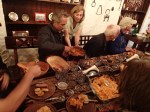
Little did we know what was in store for us. Jorge’s father, Jorge, presided over a huge barbecue and his mother, Leonor, prepared dessert for the Expedition65 team and their large extended family.

After a 500 Km day across the high, cold, desolate Andes and Ruta40 that ended with 30Km of roadworks in the dark, we fell on all this food and local wines and went to sleep in a food coma.

Jorge – thanks so much for opening your house to this dusty, dirty group of gringos. We will remember this evening for a long time.

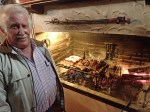
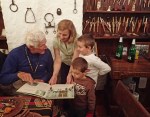
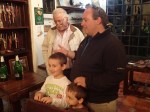
Photos: Jorge Senior at the grill with every animal imaginable sacrificed for our pleasure – Leonor serving us more food than we had any business eating – Jorge Senior, Junior and boys – Jorge’s boys are big fans of Mary Poppins and were thrilled to meet someone who was an extra in that film.

Half Way There – Leaving Bolivia

Expedition65 set out to cross 65 degrees of latitude in 65 days. We left Cartagena, Colombia at 10 degrees N on September 7th and we are now in San Pedro de Atacama, Chile which is 23 degrees S – half of our 65 degrees are now completed.

We have visited four countries – Colombia, Ecuador, Peru, and Bolivia – each one has been a challenge in its own way but Bolivia was, for sure, the hardest and most challenging riding. We have ridden many many many roads that have been substantially more dangerous than the Death Road near La Paz but we are still here regrouping in San Pedro.

In Bolivia we had some very special moments and met some amazing people and here is just a small sample….

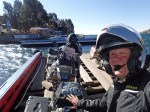
To get from the customs entry point near Copacabana, Bolivia to the capital La Paz, you have to cross a narrow part of Lake Titicaca on a fleet of independently operated barges that carry every size of vehicle – riding big bikes onto a lurching barge and then getting off backwards is one of the most unique challenges so far. Yes that is small look of panic on my face as we crossed while the barge was flexing.

The roads have been incredible. This is one shot of Chris Van Dyke on a narrow ledge along a river canyon. Yes it is as narrow as it looks and then the road went on a hair raising hairpin climb to get out and over to the next valley.

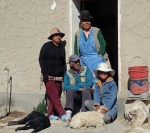
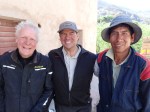
Tiberio and I took shelter in the shade of a house and chatted to the owner, Juan Paco. He told us about his farming operation, how he got tomatoes and peaches to market in La Paz, and then without pause he told us about his plans for expansion into grapes and would we American investors, like to work with him to provide external financing. Juan Paco – future Bolivian Entrepreneur of the Year. Interesting that the guy that actually took the photo is actually the boss of one of the biggest agriculture companies in the world – but not sure he wants to diversify into Bolivian wine making.

Donna Lupe and her family run a hostel on the edge of the Salar de Uyuni and managed to house 16 people when we just showed up exhausted at 9:30 at night. A crappy pile of dusty bricks from the outside but comfortable warm and clean on the inside. Never judge a hostel by its exterior.

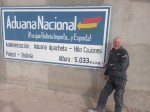
We exited Bolivian Customs at the World’s Highest Customs Post – 16,508 feet. The crew there could not have been more pleasant and helpful but I have no idea why there is a customs post at the end of a 10 Km one way road next to a borax mine.

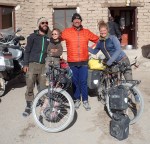
At Polques Hot Springs where we stayed at a refuge overnight, we met a German couple and their five year old boy who had cycled from Cartagena – eight months on the road and still heading south up and down the Andes. Amazing.

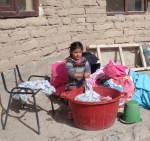
As we left the Polques refuge, the six year old daughter of the family that ran the place started to do the laundry. Her father fetched a barrel of hot water from the spring and she just got to work scrubbing and cleaning.

This has been an amazing glimpse into other people’s lives.