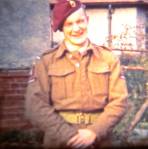


“Very likable personality, and cheerful in the most trying circumstances”
A few years ago, my sister, Sally, and I requested Dad’s military records from the Army Personnel Centre as he was notoriously reticent about his service. We received a pile of paper that meticulously recorded this five year segment of his life.
Starting with “Army Form B200a: Voluntary enlistment: Desires eventually to serve in the Royal Corps of Signals” he reported for duty in June 1942 and was sent to Catterick Camp for basic training. Then sent to technical school for training in radio and communications equipment.
Subsequently, in June 1944, he volunteered to join the 6th Airborne Division – the Red Berets. A ballsy choice to jump out of aircraft with a suitcase size radio on his back into the thick of it. Despite its name, this was only the second of two airborne divisions of the army raised in WWII and had only been formed in 1943. The records show that he was injured in a training accident and released back to active duty just in time to be sent Palestine in 1945 as part of the British Mandate to police the Jewish insurgency. An experience closely equivalent to that of those who have recently served in Iraq or Afghanistan.
He returned to the UK to be demobilized with the rest of the paras in July 1947 and was discharged to the reserves with a note that he was “eligible for recall to age 45″. He was a awarded a “War Medal 1939-1945″ and “clasp for Palestine 1945-48″ but this service was not fully recognised until 1990 – but that’s another story as they say.
His discharge at the rank of Corporal said his service was “exemplary” and said he was “A thoroughly reliable NCO, well above average in intelligence, and keen on his work. Not a good disciplinarian, but can make a good team out of the right men. Very likable personality, and cheerful in the most trying circumstances”.
The army has a talent for the understatement given what was happening then – and now – in Palestine

