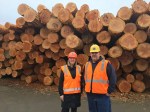
Lumber production is measured in board feet.

Despite living in Oregon timber country for almost 30 years, until last week I had no idea what a board foot was or how a lumber mill worked. Then I had the opportunity to visit the Hampton Lumber mill in Willamina, Oregon – Timbertown USA – guided by mill manager Brad Blackwell.

So … I now know that one board foot is a piece of wood 12” x 12” x 1” and the Willamina mill produces 2 million board feet of timber PER DAY – roughly 6,000 trees felled from private and public lands up and down Western Oregon.

Fun fact: one million board feet is abbreviated MMBFM – an interesting mixture of Latin (thousand thousand) and English (board foot measure).

The flow of log trucks into the this site is constant. They are quickly unloaded and the contents measured by independent government inspectors to make sure the loggers and the mill do not fall out over who paid for what. The raw logs are then trucked into a machine for removing bark and cutting to manageable lengths before rolling into the mill proper.

Walking through the mills created two distinct impressions for me. First it is exactly as you would expect – noise and sawdust and big rumbling machines managed by big burly guys in hard hats and serous Carhart outfits. The real Oregon exactly as you imagine it has been for over 150 years.

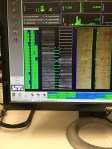
But then the degree of precision and automation and computer assistance came as a big surprise – each log is rolled and sized with lasers so that the mill can be programmed to extract the maximum amount of finished lumber at the highest possible quality – the smaller mill even has the ability to measure the shape of the log and cut timber on a curve to get 20% more out of some logs. Finished pieces are photographed on the end grain as they flash through to establish their “fingerprint” so that they can be dropped into the correct bin after grading. The adjustment of the kerf (distance between points in a saw blade) by a few thousands of an inch can make a few hundred thousand dollars difference to final lumber output.

The result of this automation certainly improves safety and injuries but it also, clearly, reduces the number of employees and increases profitability of producing lumber. There are 240 people working in this mill and it produces close to 10% of Oregon’s finished dimensional lumber output.

Comparing the 1970s to today – Oregon timber employment has gone from 80,000 to 30,000 (down 63%) while the output has gone from 8 Billion board feet to 4 Billion board feet per year (down 50%). Overall the timber industry was 12% or Oregon’s GDP in the 1970s and it is now only 2% of GDP.  

For Willamina, however, this industry is 100% of the GDP.

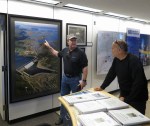
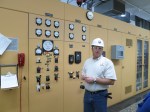
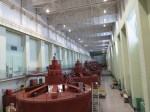
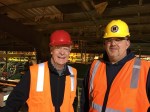
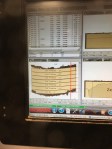
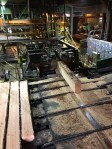
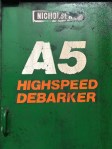
Photos: Enormous thanks to Brad Blackwell for taking three hours to show us the mill from end to end – FInished lumber about to be dried for a few days – The operator of the Quad Mill showing the screen displaying the cross section of the log and the pieces it will be cut into – Blades cutting logs to 20′ lengths for the smaller mill – Computer screens showing a curved scan and the end grain fingerprints of the finished lumber being graded – The first cut is the deepest – Serious warning signs – Beckie Lee and Brad Blackwell

https://oregoneconomicanalysis.com/2012/01/23/historical-look-at-oregons-wood-product-industry/
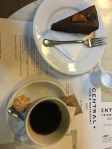
Bad Budapest Tourist.

The visit to Budapest was to celebrate the wedding of one of my oldest friends and to catch up with a few more who had also made the journey. All this didn’t leave a lot of time for exploring Budapest. We did walk along the Danube, across the Chain Bridge up to Buda Castle and Matthias Church and the sandcastle-like terrace of the Fisherman’s Bastion. We walked Andrássy Avenue and the Square of Heroes and took in the huge Christmas markets in front of St. Stephen’s and I did also manage a coffee and sacher cake in the poet’s Central Cafe. But we did not have time for the Gellert Spa and, with fascism on the march again around the world and in America, it would have been useful to visit the House of Terror Museum that documents the 1956 uprising across Hungary and its violnt repression by Stalinist Russia – but I didn’t have the energy and stomach to withstand this.

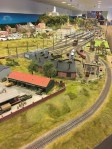
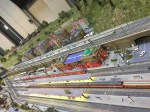
So, I went to see the Miniversum model train. Escapism at its best. This a huge model behind an unassuming single door that documents a few cities in Hungary and Austria. With a couple of kilometers of track and a hundred moving pieces, it is by no means the largest display of this kind but it is still worth an hour or more of your time to see the real and fantasy world created by the designers. In any train layout it is possible to combine different periods and this is no different. There are even little HO scale vignettes of, yes you guessed it, Life Under Communism. There are a collective farm, and drab block of flats and even sections of the Iron Curtain with guard towers and a scene that captures the fall of the wall.

So next time, the Museum of Terror.

“Very likable personality, and cheerful in the most trying circumstances”

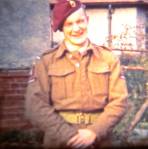
A few years ago, my sister, Sally, and I requested Dad’s military records from the Army Personnel Centre as he was notoriously reticent about his service. We received a pile of paper that meticulously recorded this five year segment of his life.

Starting with “Army Form B200a: Voluntary enlistment: Desires eventually to serve in the Royal Corps of Signals” he reported for duty in June 1942 and was sent to Catterick Camp for basic training. Then sent to technical school for training in radio and communications equipment.

Subsequently, in June 1944, he volunteered to join the 6th Airborne Division – the Red Berets. A ballsy choice to jump out of aircraft with a suitcase size radio on his back into the thick of it. Despite its name, this was only the second of two airborne divisions of the army raised in WWII and had only been formed in 1943. The records show that he was injured in a training accident and released back to active duty just in time to be sent Palestine in 1945 as part of the British Mandate to police the Jewish insurgency. An experience closely equivalent to that of those who have recently served in Iraq or Afghanistan.

He returned to the UK to be demobilized with the rest of the paras in July 1947 and was discharged to the reserves with a note that he was “eligible for recall to age 45″. He was a awarded a “War Medal 1939-1945″ and “clasp for Palestine 1945-48″ but this service was not fully recognised until 1990 – but that’s another story as they say.

His discharge at the rank of Corporal said his service was “exemplary” and said he was “A thoroughly reliable NCO, well above average in intelligence, and keen on his work. Not a good disciplinarian, but can make a good team out of the right men. Very likable personality, and cheerful in the most trying circumstances”.  

The army has a talent for the understatement given what was happening then – and now – in Palestine

“Ideas without precedent are generally looked upon with disfavor and men are shocked if their conceptions of an orderly world challenged.” 

j Harlan Bretz.

The story of the Channelled Scablands is the story of one man fighting both the establishment and conventional wisdom. 

Since the mid-1800s the recent geology of the earth had been settled. The land around us was made by a few violent episodes and then by small changes happening over unimaginably long periods of time – the earth’s crust being twisted by pressure and eroded by millennia of rains and winds. It’s called uniformitarianism.

But when J Harlen Bretz stood on the edge of the Potholes Coulee near Quincy, Washington in 1923, he could only explain the canyons ripped down to the Columbia River as the result of a violent flow of water – we now know it’s the result of the Glacial Lake Missoula floods inundating this basin before leaks developed and the escaping water and ice and rock scoured the coulees and the Columbia Gorge to let the water get to the Pacific. This did not align with settled science to the academic geology “establishment” dismissed Bretz and his hypothesis for decades. How could you have biblical floods in a desert?

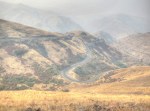
Riding around Central Washington now it is easy to see the results of the Missoula Floods. As the polar ice caps came and went from 15,000 to 18,000 years ago, water was trapped east of the Rockies for huge amounts of time. As these ice dams burst they released immensely powerful floods. This happened over 80 times and now we see a huge debris field and a scoured landscape.

For Bretz, it was only decades later, with a better scientific understanding of the Ice Age, that he was vindicated. In his 90s, he commented that he was pleased to be proven right but that he had outlived all his critics.

Photos:

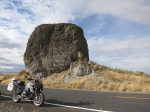
Yeager Rock – as the Missoula Floods poured across Washington, they carried rocks torn from the underlying basalt – some rocks were huge and were rafted on the ice and finally dumped hundreds of miles away and the ice melted.

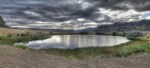
Dry Falls was once the largest waterfall in the world – with 400 feet of water plunging and tearing a path south across a rim many miles long. Now here we have Dry Falls Lake looking down the coulee towards Ephrata.

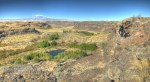
Potholes Coulee is the lowest point on the edge of the Quincy Basin where the water found an exit and scoured out these massive canyons and sheer cliffs down to the Columbia River.

Potholes Coulee from one side to the other with Mike Malone on the right edge.

Tamer Riad and Mike Malone on the edge of the Potholes Coulee.

Where Is Your Place of Zen.

Close your eyes. Think of where you would rather be. Not in traffic, or the middle seat in economy class, or watching the West burn, or reading Trump tweets. Where do you go?

I expect that for everyone the first image is one of friends and family laughing and listening around a table. The people you love, a bottle of wine, a sunny day, and a fresh meal from the garden. Hugging the kids and enjoying conversation with your friends.

After that, our reveries go all over the place. For some it’s being on a yoga mat or up to their waist in a trout stream, behind the wheel of an old car or in the front row of the opera. There are a few notions competing for my attention, but right up there is the feeling of standing on a big bike heading down a narrow track into the wilderness. There is the physical challenge, a significant element of risk, and a mental focus that pushes out all other distractions – this is an activity with a low tolerance for lapses of attention and I have had a few broken bones to prove it.

In the last few days we have ridden some of the best adventure bike roads anywhere in America. The Steens Mountain loop to Oregon’s highest road and across the trackless Alvord Desert – the Elk City Wagon Road from Grangeville, Idaho where the remnants and ruts are still there from a hundred and fifty years ago – the Magruder Trail that runs through the Frank Church Wilderness over the Bitterroots into Montana – the Lolo Motorway from Missoula high along the ridge line down to Pierce back in Idaho – the Lewiston-Enterprise Highway with its spectacular road ride down and across the Grande Ronde River into Oregon. These are all classic adventures with almost no other people out there because they are not easily accessible from any large population centre – you have to deserve them.

The ONLY disappointment has been the pall of smoke in all four states that has reminded us of the destruction around us and blocked all the views. Steens Mountain was invisible from the centre of the Alvord Desert and we could not see the Wallowas from the center of Joseph.

Pictures here :

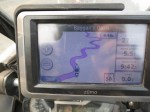
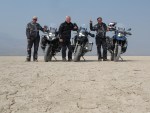
– Bill leading down French Creek Road down to the Salmon River, Idaho – Rattlesnake Grade and a view of the map on my GPS explaining why this road is called that – One of many signs warning of fire activity, this one was heading down Lolo Pass with the side roads all blocked by the National Guard – the forest either side of the Magruder Trail showing an older burn with the forest burning in the distance – Rocky Ridge Lake off the Lolo Motorway – the Alvord Desert obligatory picture with smoke blocking Steens Mountain – the gang at the start.

My New Best Friends In Kelowna – Bentley Motorrad

After 40,000 miles of tough riding in every kind of terrain, my BMW R1200GS finally stranded me with a fuel pump that was not getting the job done. It dd not just quit but started running badly enough that told me its days were numbered. Considering how much abuse this motorbike has received, this is a real testament to the durability of BMW’s dualsport machines.

I could have broken down anywhere but it must be a BMW feature that they only pack up in convenient locations. I was an hour away from one of only three BMW dealers in British Columbia so I went to Bentley Motorrad in Kelowna on Okanagan Lake.

My new best friends Gary Sampson and Victor Van Eerten (pictured here) could not have been more helpful. Got the bike apart in no time, ran through a sensible diagnostic process, quickly figured out the problem, and got the part on its way here from Vancouver.

So, one day to explore Kelowna and back on the road to chase and catch up my buddies. 

#BentleyMotorrad

Keep America Great Already

Passing through Eastern Washington one of our posse Elliot Mainzer who runs the Bonneville Power Administration, arranged for an in-depth tour of the The Grand Coulee Dam which is the beating hydro heart that feeds power into over 15,000 miles of the Bonneville power grid across the West.

The Grand Coulee was built as a New Deal project from 1933 to 1942 to create employment and to deliver power and irrigation to the Northwest. There were originally two power houses with 18 turbines producing 125 Megawatts each in addition to a series of pumps which are used to deliver water to irrigate a million acres of the Columbia Valley. The dam is operated by the Bureau of Reclamation that got its name from its mission to “reclaim” land by irrigation. Without the water from here, Eastern Washington is certainly unfarmable and essentially uninhabitable. Without the power from here, many of the most important employers and businesses in this region would not have got started; think aluminum for Boeing or data centers for Amazon.

In 1974, after an agreement on water management with Canada, a third power house was added with six more turbines; three of which deliver 690 MegaWatts each and three that deliver 805 MegaWatts each. Any one of these can deliver most of the power needs for Seattle. Taken together, this is the largest power plant in the US.

The Grand Coulee is also critical to the working of wind and solar power that is connected to the BPA grid. When the wind power varies, it is possible to increase or decrease power from the dam within seconds to allow the overall supply to remain constant. Without this buffer, wind power would be a lot harder to implement and a lot less reliable.

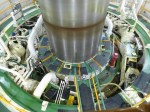
Standing above one of the larger turbines in motion is an inspiring experience; the silent power that surges around you to spin this 2000 ton blad is majestic, the numbers are staggering, and the human ingenuity to harness these forces is impressive. The project to demolish part of the dam to add the third power house is a modern engineering marvel.

But this project must have been built by a different America to the one we have now. An earlier civilization that believed in science, trusted government, and was willing to make the collective financial commitment to a massive infrastructure project that would benefit companies, families, farms, and millions of homes.

The current administration tells us that they want to Make America Great Again at the same time as they vandalise the institutions and denigrate the beliefs that have already made the country great in ways that are clearly on display at Grand Coulee. 

Photos:

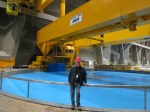
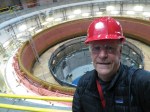
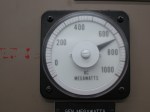
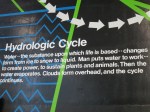
– Elliot and Scott at the Visitor Center getting the big picture – Coleman Smith with the control panel for one of the smaller turbines running 125 MWatts – The elevator calibrated in feet above sea level with the top floor accessing the top of the dam about 20 feet above the lake and the bottom floor under the turbines almost 400 feet lower – The turbine hall in one of the small power houses – The world’s largest indoor crane needed to remove the large turbines – One of the larger turbines dialed back to 750 MWatts – The stator of one large turbine under repair – Water exists to be put to work by man on a mural in the small turbine hall – The shaft of one of the large turbines and all its water control valves turning at 120 rpm with zero vibration.

Belfast: Troubles + Titanic = Tourists

Belfast seems to have reinvented itself by showcasing the tragedies of its past. The place is bustling, and confident, and almost cosmopolitan – now about 80 cruise ships dock here every year opposite the slip from which the Titanic was launched in 1912.

TITANIC

The Titanic Museum is one of the best in the world – an interactive and fascinating trip through the history of the city, the development of shipbuilding up to the Harland and Wolff epoch, and the construction and destruction of their most famous ship. “Built by Irishmen but, to be sure, crashed by an Englishman”. There is even a multi-storey adventure ride through an imagined shipyard to give you an idea of the lives of those who worked on it.

TROUBLES

The Troubles, or the Northern Ireland Conflict, is the name given to the sectarian civil war that took place from 1969, when British troops were brought in to support the Royal Ulster Constabulary who were failing to control the violence between Unionists who were generally Protestants loyal to the British crown and Nationalists who were generally Catholics who wanted a united Ireland. The end only came in 1998 when the Good Friday Agreement was signed. Over 3,500 people were killed, half of them civilians, and about 50,000 injured in this nonsense. Today the people who live here try to stick to the principles of “Remember, Respect, Resolution” but the fault lines are still there and the architecture remains to remind us.

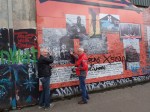
Belfast’s taxi drivers have become the de facto tour guides to the areas affected by The Troubles and we had a great afternoon with Joe who took us to see the areas that are still bedecked with competing signs of their allegiances, and grievances, and heroes – William of Orange in the Shankhill area and, in the Republican areas, murals of Patrick Pearse and James Connolly who led the Easter Rising in 1916. Joe did a terrific job explaining the history of both sides and wove in several stories of his own life and family.

Here we are adding our graffiti signatures to the “peace line” wall that separates nationalist and unionist neighborhoods and Joe showing us a picture of his grandfather who served in the British Army in the First World War. (He was injured and flagged down an ambulance only to find that it had been hijacked by two German soldiers who took him prisoner and certainly saved his life by keeping him from fighting in the Somme.)

I Love The Smell of Peat in the Morning

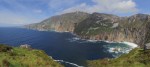
Mick Sumpter and I have been riding around Ireland from Dublin to Belfast clockwise following, where we can, the Wild Atlantic Way which is a network of roads labeled as the most scenic and which push as close as possible to the ocean. We have been largely exploring as our whims take us and we found some astonishing places that we’d never heard of – like Slieve League, the highest sea cliffs in Europe – and we have barely scratched the surface of this labyrinth.

It is obviously a cliché to describe Ireland as a country where the old and the new live side by side. But that thought pops up every day traveling around this beautiful island; old, new – ancient, modern – Irish, European.

  • Outside of the towns it is hardly possible to figure out whether a house is old or new construction. All the houses are neat and clean and unadorned and made from the same slate and the same stone and, apparently using the same building design regulations for the last couple of centuries.
  • In a country that is very traditionally Catholic and hidebound, Ireland made same-sex marriage legal with a referendum in 2015 and just chose for its new Prime Minister Leo Varadkar; the son of an Indian immigrant who is openly gay. A lesson for many other countries and especially Trumplandia.
  • There are many petrol stations in Ireland where the food available would put to shame many boulangeries and patisseries in France – seriously. Those same modern and hip petrol stations also sell home heating fuel including coal and peat – so again the 21st century meets the dark ages. The peat sold at the petrol stations is produced by a state owned company that sells peat to power stations as well as for domestic use. In addition it is common to see piles of peat that has been cut with a two-sided spade called a sleán and piled to dry.

Peat is, apparently, the most efficient carbon sink on the planet because the plants that grow on it consume the CO2 that the peat itself emits. The largest peat bog in the world is in Siberia, the size of France and Germany combined, and is, due to a warming climate, starting to thaw and release staggering amounts of climate changing methane.

So the peat fire smoke that you smell roaming Ireland is not the biggest issue facing the planet.

Good news for Ireland. Have another Guinness. Don’t mind if I do.

Pilgrimage Today – Joey’s Bar, Ballymoney

Today Facebook reminded me that it was exactly two years ago that I was at the Isle of Man TT with press accreditation thanks to Jensen Beeler and Asphalt and Rubber.

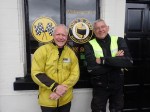
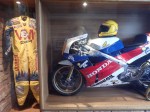
So it was appropriate that today we made a pilgrimage to Joey’s Bar in Ballymoney, Northern Ireland. This bar is still owned by the family of Joey Dunlop and serves as gathering place for the fans and the faithful and serves as a memorial to the greatest TT rider.

It is hard to grasp the achievements of Joey Dunlop with dominated the TT where he won a record 28 races including hat-tricks in 1985, 1988, and 2000. Too many racers die pursuing their chosen passion but it is doubly tragic that Joey survived the Isle of Man for 23 years (he first won in 1977 and lastly in 2000 ) before being killed in a 125cc race at a track in Estonia.

Everyone propping up the bar with pints of Guinness mid afternoon this Sunday was a serious biker and we got more advice than we could handle on the best routes and roads to explore Ireland.

Next time.